The Bolt-830CRS is an 8MP HDR MIPI CSI-2 Camera built on the Onsemi AR0830 sensor, and Vadzo has validated it with the Rockchip RK3588 for reduced power monitoring. A monitoring camera spends most of its time watching an empty scene and a small share of it recording something that matters. Streaming at full resolution all day wastes power on the empty hours, and waking slowly loses the event. The Bolt-830CRS combines wake on motion with context switching, which lets the sensor move between a low-power watch configuration and a full HDR capture configuration without reloading its settings and restarting the stream. An on-board ISP applies auto exposure and auto white balance, and the module sends Full HD or higher video over MIPI CSI-2 straight to the processor. As an 8MP WOM MIPI Camera and an 8MP Low Power HDR MIPI Camera, it also supports Raspberry Pi and NVIDIA Jetson Orin. Designed for always-on monitoring, it spends power only when there is something to see.
FORT WORTH, TX / ACCESS Newswire / October 28, 2026 / Vadzo Imaging, a provider of embedded vision camera products for OEMs and system integrators, today announces validation of the Bolt-830CRS with the Rockchip RK3588 for reduced power monitoring. The Bolt-830CRS is an 8MP HDR MIPI CSI-2 Camera built on the Onsemi AR0830 sensor, with wake-on-motion, context switching, an on-board ISP, and a two-board design that offers 2-lane and 4-lane adapter boards. With this validation, Vadzo presents an AR0830 HDR MIPI CSI-2 Camera for kiosk, security, robotics, and retail monitoring, together with guidance on how a camera can cut its average power by switching between watch and capture modes.
Why an 8MP HDR MIPI CSI-2 Camera Needs Wake on Motion and Context Switching
Monitoring is dominated by waiting. A kiosk is used for a few minutes an hour, a shelf changes a few times a day, a door opens a handful of times overnight, and a battery-powered sensor may see one event in a week. Keeping an 8MP camera streaming at full resolution and full frame rate through all of that burns power, heats the enclosure, and fills storage with empty footage. Designers therefore want the camera to watch cheaply and capture richly, and the problem is the moment of change between the two. A design that handles the watching and the capturing well but fumbles the handoff still loses the event.
Changing a sensor from one configuration to another is slower than it sounds. A typical sequence stops the stream, writes a new set of registers over a control bus, restarts the stream, and waits for exposure and white balance to settle. Each step takes time, and the sequence can cost the first frames of the very event the camera woke up for. Light makes it worse. The scene that triggers a wake is often a bright doorway, a headlight sweeping across a lot, or a window behind a person, and a camera that wakes into a low dynamic range setting clips the highlights or buries the face. HDR keeps both ends of the scene readable from the first frame.
Processing adds a third concern. A high-resolution HDR stream is heavy, and the host should not run a full imaging pipeline during the long quiet hours. Teams that choose a camera without these behaviors tend to discover the cost late, as a shorter battery life, a hotter enclosure, or a gap in the footage at the critical moment, after the hardware has been built and the processor board chosen. A short pilot that measures switching time and average power avoids most of that risk.
Platform choice completes the list. Reduced power monitoring runs on boards as different as a Raspberry Pi, a Rockchip RK3588, and the NVIDIA Jetson Orin family, and a camera that works with only one of them narrows the design, and it forces a redesign if the product later moves to a different processor.
How the 8MP HDR MIPI CSI-2 Camera Switches Between Low-Power Watch and HDR Capture
The Bolt-830CRS is built on the Onsemi AR0830, an 8MP color sensor from the HyperLux LP family, where LP stands for low power. The sensor offers HDR modes, including line interleaved HDR and enhanced dynamic range, along with wake on motion and context switching. Wake on motion lets the sensor rest at low power and return to capture when the scene changes. Vadzo has validated the camera with the Rockchip RK3588, so the processor can sleep deeply while the sensor watches. That combination is what makes the average power of the whole camera system low.
Context switching is the feature that makes the transition quick. Instead of rewriting registers and restarting the stream, the sensor holds more than one prepared configuration and moves between them at a frame boundary. A watch context might use a reduced resolution, a low frame rate, and a simple exposure setting, and a capture context might use the full 8MP frame with HDR enabled and a higher frame rate. When motion appears, the camera switches to the capture context, and the first frames of the event arrive in the right mode. The exact switching time depends on the sensor configuration and the host, so Vadzo recommends measuring it on the target board. Teams can then decide how much of the first second of an event they can afford to lose, which is usually very little.
A short calculation shows why this matters for power. Suppose, hypothetically, that a watch mode drew 0.2 watts and full capture drew 1.0 watt, and that events occupied 5 percent of the day. The average draw would be 0.2 times 0.95 plus 1.0 times 0.05, or about 0.24 watts, compared with 1.0 watt for continuous capture, a reduction of about three-quarters. These figures are illustrative and do not describe the product, but they show how the share of time spent in each mode controls the average. The on-board ISP then finishes the image inside the module, applying debayering, color correction, noise reduction, auto exposure, and auto white balance, so the RK3588 receives a finished frame and does not run a heavy pipeline during quiet hours. Consistent processing also means that footage from many units looks the same, which helps reviewers.
The module is a two-board solution, with the camera board and an adapter board in two variants, one for 2-lane MIPI CSI-2 and one for 4-lane. The 2-lane variant suits hosts with a simple camera connector, and the 4-lane variant provides the bandwidth for higher resolutions and frame rates. Vadzo supports the Rockchip RK3588, Raspberry Pi, and NVIDIA Jetson Orin Nano, Orin NX, and AGX Orin, and the connector on each carrier board determines which adapter fits. Teams should confirm the available modes, frame rates, and power figures for each context against the product documentation. A bench test with the real board and a moving target shows the achievable behavior within a day.
A practical test plan keeps the evaluation short. First, measure the idle draw of the whole system with the sensor in its watch context and the processor asleep, because that number sets the floor. Second, trigger a controlled motion and record the time from the movement to the first usable HDR frame, which combines the wake of the sensor, the switch to the capture context, the settling of exposure, and the resume of the host. Third, repeat the trigger under the lighting conditions of the real site, including the bright and dark extremes, since HDR matters most there. Fourth, leave the system running for a day or two and count the false wakes, then adjust the motion threshold and the watch region until the count is acceptable. Teams that follow these steps usually learn more in a week than a datasheet comparison can tell them, and the results carry directly into the power budget of the finished product. Vadzo supports the evaluation with engineering guidance and can suggest starting values for the watch and capture contexts.
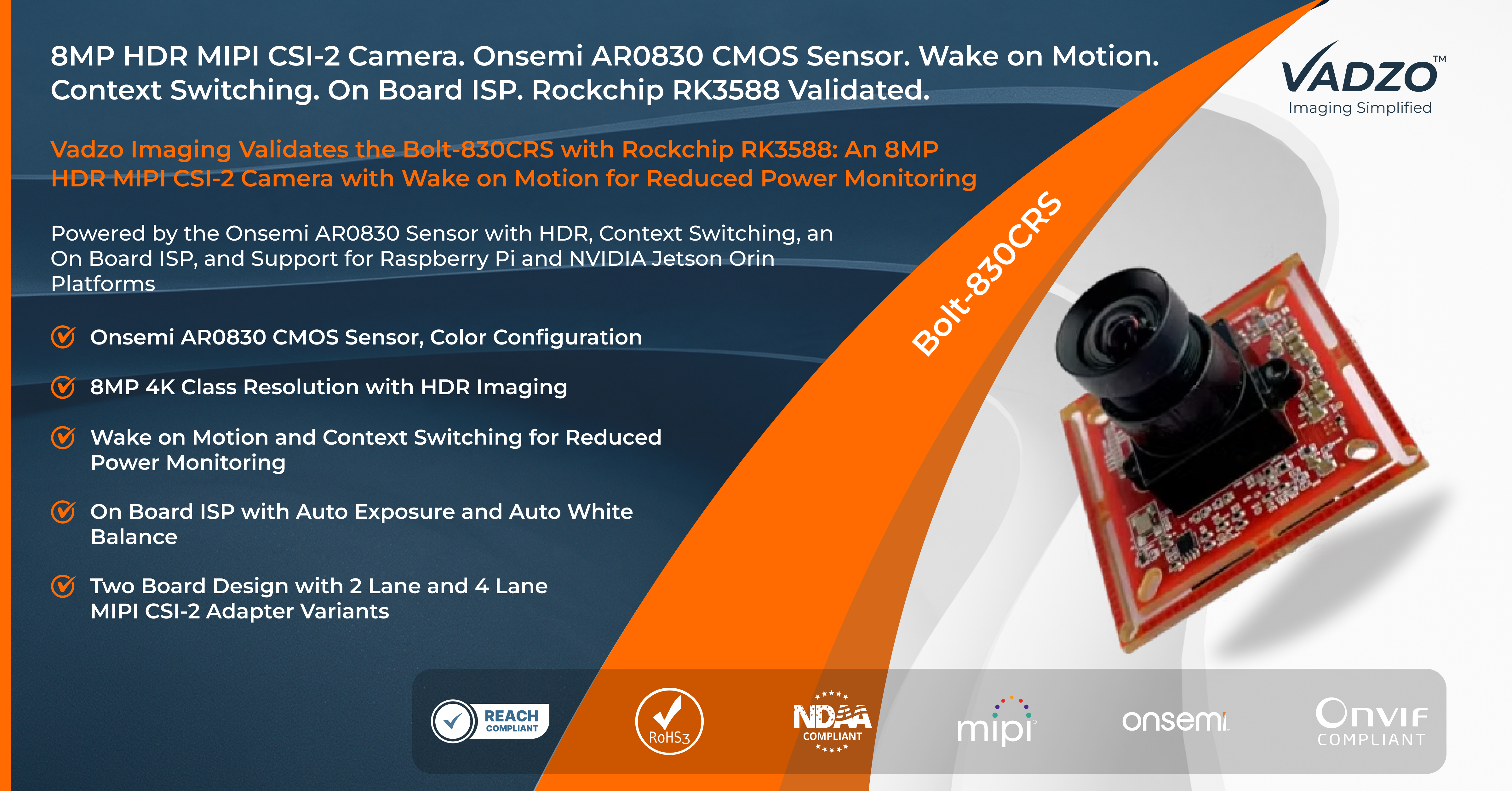
Product Overview
The Bolt-830CRS is an 8MP color MIPI module built on the Onsemi AR0830 sensor and validated with the Rockchip RK3588 for reduced power monitoring. As an 8MP RK3588 MIPI CSI-2 Camera, it sends finished frames to the RK3588 over a direct MIPI connection, and as an 8MP WOM MIPI Camera, it rests at low power and returns to capture when the scene changes. The 8MP Low Power HDR MIPI Camera designation reflects the combination of a low-power sensor family and HDR, and the 8MP Context Switching MIPI Camera designation covers the quick move between watch and capture modes. The module combines the sensor, an on-board ISP, and a MIPI CSI-2 interface in a two-board design. It also serves as an AR0830 RK3588 MIPI Camera, an 8MP Rockchip RK3588 MIPI Camera, an AR0830 Low Power MIPI Camera, an 8MP Wake-on-Motion HDR MIPI Camera, and an AR0830 WOM MIPI CSI-2 Camera for designs that need a standard MIPI interface.
Key specs: 8MP 4K Class Max Resolution | Onsemi AR0830 Sensor | Color with HDR Modes | 2 Lane and 4 Lane MIPI CSI-2 Interface | Two Board Design with Adapter Board
Key Capabilities of the 8MP HDR MIPI CSI-2 Camera
HDR Imaging for High-Contrast Monitoring Scenes
Monitoring scenes mix bright and dark regions, such as a doorway at noon, a window behind a visitor, or headlights on a dark lot. The sensor’s HDR modes keep detail in both, so faces, labels, and vehicles stay readable. Line interleaved HDR suits extreme contrast and avoids ghosting on moving subjects, at a small cost in vertical detail, and enhanced dynamic range suits moderate contrast. Teams should record the real scene in each mode and compare, ideally at noon and at dusk, since the benefit depends on how extreme the contrast is.
Wake on Motion for Low-Power Monitoring
Wake on motion lets the sensor rest at low power and return to capture when the scene changes, which lowers energy use, reduces heat in sealed enclosures, and avoids filling storage with empty footage. The motion threshold should be tuned at the real site, since shadows, passing lights, and moving branches can cause false wakes. An AR0830 Context Switching MIPI Camera can then move straight into the capture configuration when a real event begins. Recording a few nights of footage at the site shows how often the camera wakes and why.
Context Switching Between Low-Power Watch and HDR Capture
Context switching lets the sensor hold more than one prepared configuration and move between them at a frame boundary, without reloading its registers and restarting the stream. A watch context saves power with a reduced resolution and frame rate, and a capture context delivers the full HDR frame. The quick switch means the first frames of an event arrive in the right mode. Vadzo recommends measuring the switching time and the first usable frame on the target board, since both depend on the host as well as the camera.
Onboard ISP for Image Processing and Reduced Host Workload
The on-board ISP finishes the image inside the module, applying auto exposure and auto white balance, so the host receives a processed frame and does not run a heavy imaging pipeline during quiet hours. An 8MP On-board ISP MIPI Camera of this kind, which is also an 8MP Image Signal Processor MIPI Camera and an AR0830 on-board ISP MIPI Camera, gives the same color on every platform. Teams that need raw data and custom tuning should discuss a raw sensor module with Vadzo. For most monitoring projects, a finished image from the first day shortens development.
Rockchip RK3588 Validation for Low-Power Camera Monitoring
Vadzo has validated the camera with the Rockchip RK3588, a capable processor with an image pipeline, a hardware video encoder, and a neural processing unit. The RK3588 can sleep deeply while the sensor watches, then process and encode video when the camera wakes it. Because the camera sends a finished image, the RK3588 does not need to tune its own ISP for the sensor, which saves development time that would otherwise go to the product’s own software.
Camera Integration with Raspberry Pi and NVIDIA Jetson Orin
The module also works with Raspberry Pi and with NVIDIA Jetson Orin Nano, Orin NX, and AGX Orin, which lets a team prototype on a familiar board and move to the processor that suits the product. As an NVIDIA Jetson MIPI Camera and an Orin Jetson MIPI Camera, it keeps the camera constant while compute changes, and the connector on each carrier board determines which adapter fits. A team can validate the camera once and reuse that work across several boards.
Full HD Video Streaming Over MIPI CSI-2
Full HD is the working resolution for much monitoring software, and the module streams it over MIPI CSI-2 directly to the processor, which avoids the weight and power of a USB controller. The 4-lane adapter provides the bandwidth for higher resolutions and frame rates in the capture context. Teams should confirm the available modes and rates for each context before they design the pipeline around them. A short bench test with the real processor shows the rate each context can sustain.
Two-Board Design with 2-Lane and 4-Lane MIPI CSI-2 Adapters
The module is a two-board solution, with the camera board and an adapter board, and the adapter comes in two variants, one for 2-lane MIPI CSI-2 and one for 4-lane. Teams choose the variant that matches the carrier board and the frame rate they need, and they can change it later without changing the camera board. As an AR0830 MIPI Camera Manufacturer, Vadzo supports adapter selection, lens matching, firmware customization, and enclosure design for volume programs. Teams moving from a bench test to a pilot keep the same module and documentation.
“Monitoring is mostly waiting, and the best way to save power is to spend less of it on empty scenes. The Bolt-830CRS was validated with the Rockchip RK3588 around that idea. Wake on motion lets the camera rest, context switching moves it to a full HDR capture mode without a slow restart, and the on-board ISP keeps the processor’s workload light. We are clear about the limits. Switching time and first frame quality depend on the configuration and the host, so we encourage customers to measure them on their own board and to tune the motion threshold at the real site. The saving comes from the share of time spent watching, not from any single number, and that is why we ask customers to look at a full day of real footage before they judge the result.” – Alwin Vincent, Product Manager, Vadzo Imaging.
Low-Power Monitoring Applications for the 8MP HDR MIPI CSI-2 Camera
Kiosk Monitoring with Wake on Motion and HDR Imaging
Kiosks and signage sit idle most of the day and need a camera only when someone approaches. The Bolt-830CRS works as a Reduced Power Monitoring MIPI Camera that rests until a visitor arrives and then captures a clear HDR frame, even with a bright window behind the user. The lower energy use also eases heat in sealed enclosures, and a wide dynamic range keeps faces readable when the kiosk faces a window or an entrance. Kiosk makers can keep one camera across product lines and change only the lens.
Low-Power Security Monitoring for Doors, Gates, and Perimeters
Doors, gates, and perimeters are quiet most of the night. The camera serves as a Low-Power Security MIPI Camera and a Motion-Triggered Monitoring MIPI Camera that wakes on motion and switches to a full HDR capture mode, so headlights and bright entrances do not wash out the scene, and recorded clips begin in the right mode from the first frame. Installers should tune the motion threshold to avoid false wakes from shadows and moving branches, and they should repeat the tuning after any change in lighting near the camera. Sites with limited power, such as gates and remote buildings, gain the most from the rest and wake approach.
Battery-Powered Monitoring for Robotics and Remote Sensors
Battery-powered robots and remote sensors cannot afford a camera that streams all day. The module works as a battery-powered monitoring MIPI Camera that watches cheaply and captures richly when something changes, and the RK3588 or a Jetson Orin module can sleep between events. Teams should check the whole system’s draw, since the host often decides the total. Mobile platforms should also confirm connector retention and vibration limits, and robots that move between lit and dark areas benefit from the HDR capture mode.
Retail Shelf and Aisle Monitoring with Wake on Motion
Stores need camera units that watch shelves, entrances, and counters through long quiet periods. The module functions as an Always On Monitoring MIPI Camera that spends little power on empty aisles and switches to HDR capture when a shopper or a delivery appears, handling window glare and bright displays. Chains that standardize on one module simplify spares and training across stores, and a quiet camera also reduces the volume of footage that staff must review. A short test in the real store settles which HDR mode suits each position.
Frequently Asked Questions
Q: What is context switching in an image sensor?
A: Vadzo Imaging explains it simply: the sensor holds more than one prepared configuration, such as a low-power watch setup and a full HDR capture setup, and moves between them at a frame boundary. Without it, changing modes means stopping the stream, rewriting registers, and restarting, which takes time and can cost the first frames of an event. An 8MP Context Switching MIPI Camera makes the change quicker, though the exact time depends on the configuration and the host, and a short measurement on the target board gives the real figure.
Q: Why does a monitoring camera need both wake on motion and HDR?
A: Wake on motion saves power by letting the camera rest until something changes, and HDR keeps the event readable when it happens. The scenes that trigger a wake are often a bright doorway, a headlight, or a window behind a person, and a camera that wakes into a standard exposure clips highlights or buries faces. A Low Power Security MIPI Camera with both features rests cheaply and captures clearly, and Vadzo Imaging recommends testing both at the real site, in the real lighting, with real visitors.
Q: How can an always-on camera cut its average power?
A: By spending most of its time in a low-power watch mode and switching to full capture only for events. The average depends on the share of time in each mode. For example, hypothetical draws of 0.2 watts in watch mode and 1.0 watt in capture mode, with events 5 percent of the time, give an average of about 0.24 watts. Vadzo Imaging reminds teams that the host computer often decides the total, so the whole system should be measured. An Always On Monitoring MIPI Camera is only as efficient as the board that receives its video.
Q: How does a MIPI camera work with Rockchip RK3588 and NVIDIA Jetson boards?
A: A MIPI camera connects directly to the processor through a 2-lane or 4-lane interface, and the correct adapter depends on the connector on the carrier board. An 8MP RK3588 MIPI CSI-2 Camera sends finished frames to the Rockchip processor, and an NVIDIA Jetson MIPI Camera setup works the same way on the Orin family. Vadzo Imaging supports both with the same camera board and helps teams choose the adapter, so the same camera board can follow a project from a Raspberry Pi prototype to a production design.
Q: Why should integrators choose Vadzo Imaging as their 8MP MIPI Camera Manufacturer for low power monitoring?
A: Vadzo Imaging offers more than a camera module built around a capable sensor. Integrators working with Vadzo Imaging receive a module with wake on motion, context switching, HDR, and an on-board ISP, validated with the Rockchip RK3588, along with candid guidance on switching time, false wakes, and whole system power, plus engineering support for lens selection, firmware customization, and enclosure design. Vadzo Imaging maintains evaluation kits with no minimum order requirement, so teams can measure power on their own hardware before committing to volume production.
Availability
The Bolt-830CRS 8MP HDR MIPI CSI-2 Camera built on the Onsemi AR0830 sensor is available now for evaluation and production orders. Evaluation kits include the camera module, the 2-lane or 4-lane adapter board, and platform documentation, with no minimum order requirement. Teams can measure switching time, first frame quality, and average power on their own Rockchip RK3588 or NVIDIA Jetson Orin board, and tune the motion threshold at their own site before committing to a production bill of materials, which tells them more than a datasheet comparison alone. Teams that need a different lens or adapter configuration can ask Vadzo to review the setup. Browse the full range of MIPI camera options at Vadzo’s website or discuss OEM integration requirements for kiosk, security, robotics, and retail monitoring programs.
About Vadzo Imaging
Vadzo Imaging is a global provider of embedded vision solutions and delivers high-performance camera technologies and imaging platforms for applications in robotics, industrial automation, UAVs, edge AI, and medical systems. Its products are designed for seamless integration with leading embedded platforms including Rockchip, NVIDIA Jetson, Raspberry Pi, and NXP i.MX. Vadzo supports customers through hardware customization, firmware development, and module-level drivers, enabling faster development and deployment of vision-based systems across MIPI, USB, GigE, Wi-Fi, and SerDes camera interfaces.
Media Contact
Alwin Vincent
Vadzo Imaging
Email: alwin@vadzoimaging.com
LinkedIn: Vadzo Imaging
YouTube: Vadzo Imaging
X: Vadzo Imaging
SOURCE: Vadzo Imaging
View the original press release on ACCESS Newswire
Media gallery