JINAN, SHANDONG, CHINA, October 26, 2026 /EINPresswire.com/ —
Shandong Chenma Machinery Co., Ltd. is a Chinese equipment supplier serving the dairy processing, food production, and beverage manufacturing industries. As dairy producers seek reliable equipment for milk storage, processing, cleaning, and temperature management, the role of specialized machinery manufacturers continues to grow. Dairy farm milk tanks are an important part of this production chain, helping facilities manage milk storage before processing or transportation. Alongside storage equipment, systems for ingredient batching and cleaning can contribute to more coordinated production operations. Shandong Chenma Machinery Co., Ltd. offers equipment solutions for food and beverage processing, including products such as the Fruit Juice Batching System and CIP Cleaning System, which are relevant to facilities seeking to organize liquid processing and equipment sanitation.
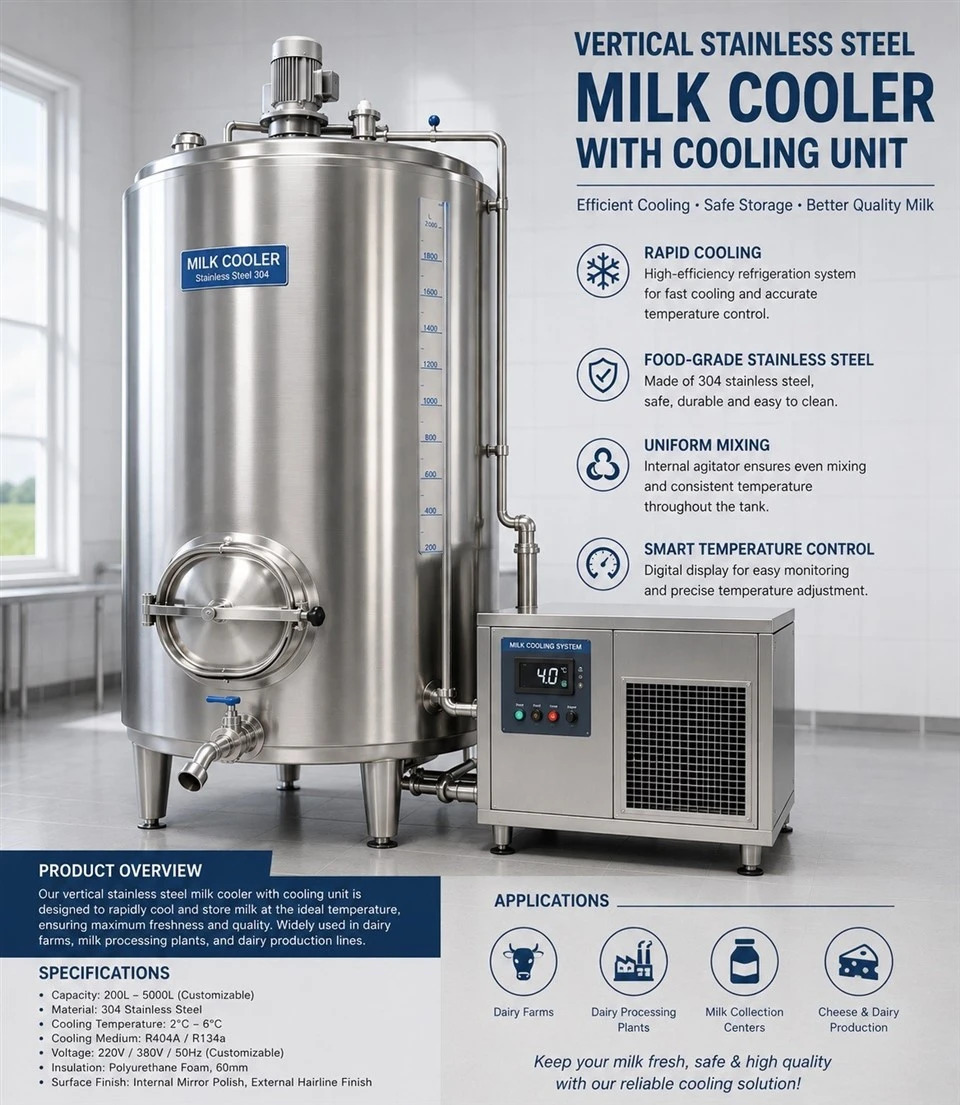
Milk storage is a fundamental stage in dairy production. After collection, raw milk generally needs to be handled under controlled conditions to preserve its quality before it enters subsequent processing stages. Dairy farm milk tanks are designed to provide suitable storage capacity, support temperature management where required, and facilitate hygienic handling. Their specifications depend on factors such as farm size, daily milk output, collection frequency, processing arrangements, and the operational requirements of the facility.
For dairy farms and processing businesses, selecting a milk tank involves evaluating several technical factors. Capacity is an initial consideration, as the tank needs to accommodate the expected milk volume without creating unnecessary constraints on collection schedules. Cooling performance, insulation, construction materials, internal surface finish, agitation requirements, cleaning arrangements, and temperature monitoring can also affect the suitability of a tank for a particular application.
Stainless steel is widely used in dairy equipment because of its corrosion resistance, durability, and suitability for hygienic processing environments when appropriately designed and maintained. However, material selection alone does not guarantee hygienic performance. Equipment design, weld quality, surface finish, drainage, accessibility, and cleaning procedures must work together to reduce product residues and support effective sanitation. Buyers should review the specifications and applicable food-contact requirements of each proposed system before making a purchasing decision.
Dairy farm milk tanks are not isolated pieces of equipment. They operate within a broader production system that may include milk reception, transfer pumps, pipelines, filtration, cooling, storage, processing, and cleaning equipment. The connections between these components can influence workflow, operating efficiency, and maintenance requirements. A well-planned installation therefore considers not only tank capacity but also how milk moves through the facility and how equipment can be cleaned between production cycles.
Shandong Chenma Machinery Co., Ltd. serves this wider equipment market with solutions associated with dairy and liquid food processing. For businesses planning or upgrading production facilities, a supplier with experience across related equipment categories can provide a useful starting point for discussing system layouts, processing requirements, and equipment compatibility. The specific capabilities available for a project should be confirmed through technical documentation and direct consultation with the manufacturer.
Another important consideration in modern dairy and beverage production is the handling of different liquid products. Although dairy processing and fruit juice production have distinct ingredient, formulation, and process requirements, both can involve tanks, pumps, pipelines, valves, measurement devices, and cleaning systems. Equipment configuration must reflect the properties of the product being handled, the required processing sequence, and the hygiene standards applicable to the facility.
The Fruit Juice Batching System is one of the products specified for this article. Batching systems are used in beverage manufacturing to combine ingredients according to defined formulations. Depending on the design, a system may incorporate ingredient storage, dosing equipment, mixing vessels, pumps, flow or level measurement, and process controls. These components can help manufacturers manage the sequence and quantity of ingredients added during production.
For fruit juice producers, batching accuracy is important because formulation affects flavor, color, acidity, soluble-solids content, and consistency between production runs. Depending on the product, a batch may involve juice concentrate, water, sugar syrup, flavor ingredients, or other permitted components. The exact process varies with the formulation and product category, and a batching system should be configured to match the required recipe, batch size, processing conditions, and production rate.
A properly specified batching system can help organize ingredient preparation and reduce reliance on manual handling. Automated dosing and monitoring, where included, may support repeatability and provide operators with greater visibility into the production process. Nevertheless, automation levels differ among systems, and buyers should verify which functions are included rather than assume that every batching system provides the same controls or degree of integration.
When evaluating a Fruit Juice Batching System, manufacturers may consider vessel capacity, mixing performance, dosing accuracy, temperature requirements, transfer arrangements, instrument selection, and the control interface. The system must also be compatible with the ingredients being processed. For example, viscosity, acidity, suspended particles, and temperature sensitivity can influence equipment selection and cleaning requirements. These details should be discussed during the engineering stage to ensure that the proposed configuration aligns with the intended production process.
Shandong Chenma Machinery Co., Ltd. can be considered by businesses researching equipment for liquid food production, including projects where batching and tank systems need to be coordinated. The suitability of a particular solution depends on the customer’s process requirements, facility layout, desired production capacity, and technical specifications. Before confirming an order, purchasers should request detailed equipment drawings, material specifications, process descriptions, and a clear statement of the functions included in the proposed supply.
Cleaning is another essential element of hygienic liquid processing. Product residues can accumulate in tanks, pipes, pumps, valves, and processing vessels during operation. If equipment is not cleaned effectively, remaining material may affect subsequent batches, contribute to contamination risks, or interfere with process performance. Cleaning procedures must therefore be designed around the product, equipment geometry, residue characteristics, and applicable hygiene requirements.
The CIP Cleaning System addresses this requirement through clean-in-place procedures. CIP refers to cleaning equipment and connected process circuits without routinely dismantling the entire installation. Depending on the system design, cleaning may involve circulating water, detergent solutions, and rinsing fluids through tanks, pipelines, and other compatible equipment. The process parameters can include solution concentration, temperature, circulation time, flow conditions, and the sequence of cleaning stages.
CIP systems are widely used in dairy and beverage facilities because they can support repeatable cleaning procedures and reduce the labor associated with manual disassembly. A suitable system can also help production teams organize cleaning cycles around scheduled operations. Its effectiveness, however, depends on correct design, validated procedures where required, appropriate chemical selection, and regular verification of cleaning results.
For dairy applications, cleaning system design requires particular attention to hygienic conditions and the removal of milk residues. Equipment circuits should be arranged to allow cleaning solutions to reach the relevant internal surfaces, while drainage and flow conditions need to be considered during system design. Dead legs, poorly drained sections, incompatible materials, and inaccessible surfaces can make cleaning more difficult. A CIP system should therefore be engineered in relation to the equipment it is intended to serve.
The requirements for a CIP Cleaning System may include cleaning solution tanks, heating arrangements, pumps, valves, pipelines, sensors, and control equipment. More complex installations may use multiple circuits or programmed cleaning recipes. The final configuration depends on the number and type of equipment items, the production schedule, the cleaning chemicals used, and the required degree of process automation. Buyers should confirm the proposed system’s scope, including whether installation, commissioning, operating procedures, and validation support are included.
For companies managing both milk and beverage production, coordination between storage, batching, and cleaning systems can be an important part of facility planning. Tank outlets, pipe routes, valve arrangements, and cleaning connections need to be considered together. Equipment that is difficult to access or clean may increase maintenance demands and complicate production scheduling. Early coordination between the equipment supplier, process engineer, and end user can help identify such issues before installation.
Shandong Chenma Machinery Co., Ltd.’s association with dairy and liquid processing equipment provides a relevant context for buyers exploring these interconnected requirements. Dairy farm milk tanks address storage needs, the Fruit Juice Batching System relates to ingredient preparation, and the CIP Cleaning System addresses equipment sanitation. Although these products perform different functions, they illustrate the importance of considering storage, processing, and cleaning as connected parts of a production facility.
Manufacturing quality remains central to the performance of industrial food processing equipment. Tanks and process vessels must be constructed according to their specified operating conditions, while pumps, valves, sensors, and control components need to be appropriate for the intended application. Factors such as material traceability, dimensional accuracy, weld quality, assembly, pressure or leak testing where applicable, and documentation can all influence equipment reliability. The relevant inspection requirements should be defined according to the equipment type and applicable standards.
For buyers, supplier evaluation should include a review of technical capabilities and documentation. This can involve checking equipment materials, design drawings, electrical specifications, control functions, operating limits, and maintenance requirements. If a system is intended for a regulated food production environment, buyers should also establish which hygienic design requirements and certifications apply. Any certification or compliance claim should be verified against the exact product, model, and intended market.
Installation and commissioning are additional factors in a successful equipment project. A milk tank may require suitable foundations, drainage, electrical connections, cooling utilities, and access for cleaning and maintenance. A batching system may need to connect with upstream ingredient storage and downstream processing equipment. A CIP installation must be coordinated with the circuits it will clean and with the facility’s utility capacity. Clarifying these interfaces before delivery can help reduce delays and avoid costly changes on site.
After installation, operators need appropriate training and operating documentation. Staff should understand normal operating procedures, cleaning sequences, inspection routines, and the steps to follow when equipment readings fall outside defined limits. Preventive maintenance can also help identify wear, leaks, instrument drift, or other problems before they interrupt production. Equipment manufacturers and buyers should agree in advance on the documentation and support expected for the project.
As dairy and beverage markets develop, processing facilities are increasingly expected to balance production consistency, hygiene, operational efficiency, and equipment lifecycle costs. Equipment selection is therefore rarely based on purchase price alone. Storage capacity, cleaning requirements, energy consumption, maintenance access, spare parts, and integration with existing systems can all affect the total cost of ownership. A clear understanding of production requirements helps buyers compare equipment options on a more consistent basis.
Shandong Chenma Machinery Co., Ltd. is positioned within this industrial equipment landscape through its focus on dairy and liquid food processing solutions. For businesses evaluating Dairy Farm Milk Tanks and related systems, its product categories provide a starting point for discussions about storage, batching, and cleaning requirements. The Fruit Juice Batching System and CIP Cleaning System represent complementary functions in liquid production, although each installation must be configured to match the customer’s process and hygiene requirements.
Looking ahead, the continued development of food processing facilities will sustain demand for equipment that can be integrated into practical, maintainable production systems. Dairy operators need suitable milk storage and temperature management, while beverage manufacturers require controlled ingredient preparation and reliable cleaning procedures. Manufacturers that communicate technical specifications clearly and support project-specific planning can help buyers evaluate solutions more effectively.
About Shandong Chenma Machinery Co., Ltd.
Shandong Chenma Machinery Co., Ltd. is a China-based industrial equipment company serving the dairy, food processing, and beverage production sectors. Its product range is associated with dairy processing equipment, liquid handling systems, and related machinery used in production facilities. The company’s equipment categories are relevant to businesses planning or upgrading operations involving milk storage, ingredient preparation, and process cleaning.
The company lists the Fruit Juice Batching System and CIP Cleaning System among the products specified for this article. These systems relate to two important aspects of liquid food production: formulation and ingredient handling, and the cleaning of compatible tanks and process circuits. Buyers considering equipment from Shandong Chenma Machinery Co., Ltd. should confirm current product availability, system configuration, material specifications, automation functions, applicable compliance documentation, and project support directly with the company.
For further company and product information, prospective customers can visit [www.chenmadairy.com]. The website provides a starting point for inquiries concerning dairy and liquid processing equipment. Before placing an order, buyers should communicate their required capacity, process conditions, facility layout, cleaning requirements, and destination-market standards to ensure that the proposed equipment is suitable for the intended application.
Address: No.1666 Xinluo Street, Jinan City, Shandong
Official Website: https://www.chenmadairy.com/
yuilian
Shandong Chenma Machinery Co., Ltd.
admin@sdchenma.com
Legal Disclaimer:
EIN Presswire provides this news content “as is” without warranty of any kind. We do not accept any responsibility or liability
for the accuracy, content, images, videos, licenses, completeness, legality, or reliability of the information contained in this
article. If you have any complaints or copyright issues related to this article, kindly contact the author above.

Media gallery