SUZHOU, JIANGSU, CHINA, October 23, 2026 /EINPresswire.com/ —
Suzhou Yonghecheng Fan Industrial Co., Ltd. is developing its presence in the industrial ventilation market through its focus on fan design, manufacturing, and customized airflow solutions. Established in 1997 and based in Suzhou, Jiangsu Province, China, the company serves industrial sectors that require reliable air movement, ventilation, exhaust, and process gas handling. As manufacturers place increasing emphasis on production efficiency, environmental management, and equipment reliability, the role of industrial fans continues to grow across applications ranging from heating, ventilation, and air conditioning (HVAC) to chemical processing, metallurgy, energy, and environmental protection. The company’s product portfolio includes axial fans, centrifugal fans, and related components designed to support different operating requirements.
Industrial fans are essential components in many production and infrastructure systems. They help move air and gases, remove heat, support ventilation, and transport exhaust streams through ducts and processing equipment. However, not all fan systems operate in the same way. Airflow volume, static pressure, gas temperature, material compatibility, installation space, and operating environment all influence the choice of fan technology. For buyers researching a Top Axial Fans manufacturer, understanding these factors is an important starting point for selecting equipment that meets the needs of a particular application.
Axial fans and centrifugal fans are two widely used categories of industrial air-moving equipment. Axial fans move air primarily along the axis of the rotating impeller, making them suitable for applications that require substantial airflow with relatively low or moderate resistance. Centrifugal fans use a rotating impeller to accelerate air outward before directing it through the fan outlet, making them useful in systems that require pressure to overcome resistance in ductwork, filters, and other equipment. Selecting the appropriate design depends on the requirements of the complete ventilation or process system.
Suzhou Yonghecheng Fan Industrial Co., Ltd. provides industrial fan solutions for different operating conditions, including applications involving high temperatures, elevated pressure, corrosive environments, and explosion-related safety considerations. Its publicly presented product categories include Axial Fans, Centrifugal Fans, and Fan Fittings. These product groups allow industrial buyers to consider both airflow-generating equipment and the supporting components needed for installation and system integration.
Axial Fans for Industrial Ventilation and Cooling
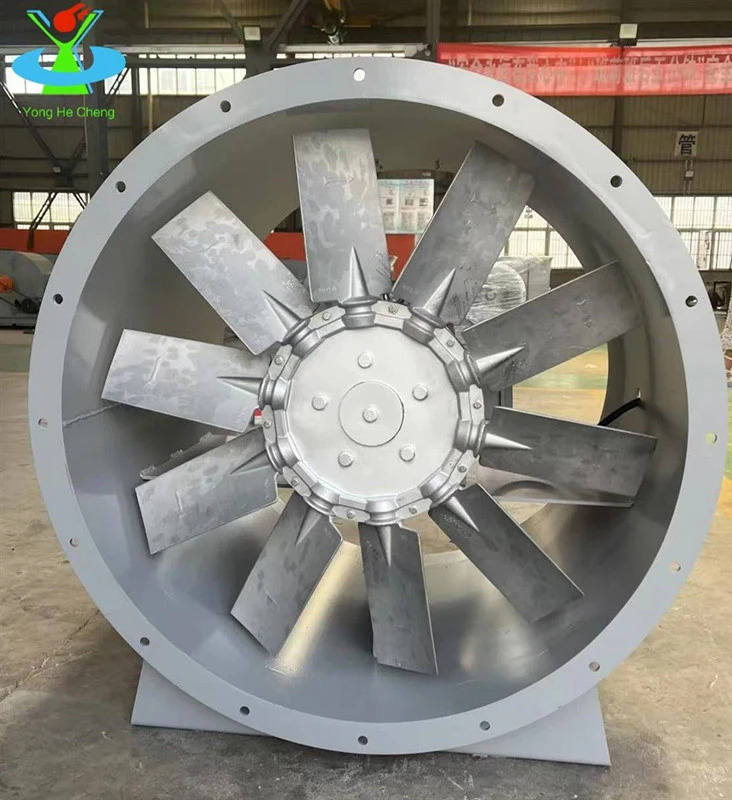
Axial fans are commonly used when air needs to move through a space or ventilation system in a relatively direct direction. Their design can provide high airflow rates without requiring the same pressure characteristics as many centrifugal fan applications. Depending on their configuration, axial fans can support general ventilation, equipment cooling, exhaust, and air circulation in industrial buildings and specialized facilities.
The performance of an axial fan depends on factors such as impeller design, rotational speed, motor power, blade geometry, and system resistance. If ductwork, filters, louvers, or other components create excessive resistance, the delivered airflow may differ from the expected value. Buyers should therefore evaluate the fan against the complete system curve rather than selecting equipment based only on a maximum airflow figure.
Suzhou Yonghecheng Fan Industrial Co., Ltd. lists multiple axial fan configurations, including direct-driven axial fans, belt-driven axial fans, explosion-proof axial-flow fans, high-pressure axial fans, and high-flow axial fans. Different configurations offer different installation and operating characteristics. A direct-driven design connects the impeller to the motor without a belt transmission, while a belt-driven arrangement can provide flexibility in speed selection depending on the motor and pulley configuration.
For industrial facilities, axial fans may be considered for general ventilation, cooling systems, workshops, and other applications where large volumes of air must be moved. The specific model should be chosen according to the required airflow, pressure, temperature range, noise limits, and mounting conditions. Where the air contains dust, moisture, or corrosive substances, material selection and protective measures also require careful consideration.
The company’s published product information identifies carbon steel, stainless steel, and aluminum alloy among the materials used for certain axial fan models. The appropriate material depends on the intended environment, mechanical demands, and exposure to potentially damaging substances. For applications involving aggressive gases or unusual operating temperatures, buyers should confirm material compatibility and the fan’s rated operating limits with the manufacturer.
Centrifugal Fans for Higher-Resistance Systems
While axial fans are often associated with high-volume airflow, centrifugal fans are frequently selected for applications where the system must overcome greater resistance. These fans use centrifugal force generated by a rotating impeller to move air from the inlet toward the outlet. Their performance characteristics depend on impeller geometry, housing design, rotational speed, and the operating point within the connected system.
Centrifugal fans can support industrial exhaust, dust collection, furnace ventilation, chemical processing, and other applications where airflow must pass through ducts, filters, heat exchangers, or process equipment. Different impeller designs address different combinations of airflow, pressure, efficiency, and material-handling requirements.
Suzhou Yonghecheng Fan Industrial Co., Ltd. identifies centrifugal fan research, development, and manufacturing as a central part of its business. Its product range includes forward-curved centrifugal fans, backward-curved centrifugal fans, radial-blade fans, and other specialized configurations. These designs differ in their operating characteristics and suitability for particular applications.
Forward-curved centrifugal fans may be suitable for certain ventilation and air-handling systems requiring substantial airflow at comparatively modest pressure levels. Backward-curved designs are commonly considered when efficiency is an important selection criterion. Radial-blade designs may be used in demanding industrial environments where robust construction and the handling of air containing particles are relevant considerations. The final choice depends on the properties of the conveyed gas and the pressure and flow requirements of the system.
The company also presents customized industrial fan solutions for operating environments involving high temperatures, high pressure, corrosion resistance, and explosion protection. Such applications require engineering decisions that extend beyond the fan’s basic airflow rating. Materials, sealing arrangements, motor specifications, bearing selection, impeller construction, and operating conditions can all affect performance and service life.
For buyers comparing industrial fan manufacturers, detailed performance data can help establish whether a proposed model fits the intended application. Relevant information may include airflow curves, static pressure, motor power, rotational speed, efficiency, temperature limits, and permissible installation conditions. Confirming these details before procurement helps reduce the risk of selecting a fan that cannot meet the actual system requirements.
Fan Fittings and Complete System Integration
An industrial fan is rarely used in isolation. Its performance and reliability can depend on the quality of the surrounding installation, including connectors, silencers, vibration-control components, mounting arrangements, and ductwork. These supporting components help connect the fan to the broader ventilation or process system and address installation-specific requirements.
Suzhou Yonghecheng Fan Industrial Co., Ltd. includes Fan Fittings in its product portfolio. Its published product categories include fan silencers, silencer boxes, rubber and spring shock absorbers, and flexible connectors made from materials such as canvas and PVC. These accessories serve different functions and can be selected according to airflow conditions, pressure requirements, noise-control objectives, and mechanical installation needs.
Fan silencers are used to help reduce noise associated with airflow and equipment operation. The amount of noise reduction depends on the design, installation, frequency characteristics, and operating conditions. Silencer selection should also consider pressure drop, available space, and the required airflow, because an accessory that creates excessive resistance can affect overall system performance.
Vibration-control components are another consideration in industrial fan installations. Rotating equipment can generate vibration from several sources, including imbalance, alignment issues, structural resonance, and operating conditions. Rubber or spring shock absorbers may help isolate vibration between equipment and supporting structures when appropriately selected. They do not replace the need for proper balancing, installation, alignment, and routine inspection.
Flexible connectors can provide a connection between a fan and adjacent ductwork while accommodating limited movement and helping reduce the transmission of vibration. The material, dimensions, pressure rating, temperature resistance, and compatibility with the conveyed medium should be reviewed before installation. For systems handling hot gases, corrosive substances, or demanding pressure conditions, buyers should confirm that the selected connector is designed for the specific service.
Integrating Fan Fittings with the main fan equipment can simplify procurement and help ensure that related components are considered during system planning. However, compatibility should always be confirmed against the fan model and operating conditions. Buyers may need to review connection dimensions, airflow capacity, pressure limits, mounting requirements, and maintenance access before finalizing a configuration.
Manufacturing Capabilities and Customized Fan Design
Industrial fan manufacturing involves multiple stages, including engineering design, material preparation, component fabrication, impeller production, assembly, balancing, and testing. Accuracy at each stage can influence mechanical stability, operating noise, efficiency, and the ability of the finished product to perform consistently.
According to its published company information, Suzhou Yonghecheng Fan Industrial Co., Ltd. operates a manufacturing facility equipped with CNC machine tools, laser-cutting equipment, dynamic balancing machines, and testing instruments. The company states that its engineering and production capabilities support customized fan solutions for customers with different technical and installation requirements.
Customization can be important when standard equipment does not fit a project’s operating conditions. A fan may need a particular airflow rate, static pressure, motor power, voltage, rotational speed, mounting configuration, or material specification. Special applications may also require adjustments for temperature, corrosion resistance, dust exposure, or safety considerations.
The company describes customized solutions covering axial and centrifugal fan systems. For engineering teams, an effective customization process begins with clear operating data. Buyers should provide the required airflow, system resistance, gas composition, temperature, installation environment, available power supply, and relevant safety requirements. Where possible, sharing system drawings and details of connected equipment can help the manufacturer assess the application more accurately.
Quality management is another important factor when selecting an industrial fan supplier. Suzhou Yonghecheng Fan Industrial Co., Ltd. reports that its products and manufacturing systems are supported by quality-related certifications, including ISO 9001, ISO 45001, CE, and UL references in its public company information. Buyers should confirm the exact certification scope and its applicability to the specific product and destination market before relying on these credentials for compliance purposes.
Testing and balancing are especially relevant to rotating machinery. Proper dynamic balancing can help reduce vibration associated with impeller imbalance, while factory testing can provide information about the equipment’s operating characteristics. For project-specific orders, buyers should clarify the inspection process, acceptance criteria, documentation, and performance data that will be supplied with the finished equipment.
Applications Across Industrial Sectors
Industrial fans support a wide range of industries, but each sector presents different operational challenges. In environmental protection systems, fans may be used to move exhaust gases through dust collection or treatment equipment. In chemical processing, the fan may need to handle gases with particular temperature or corrosion characteristics. In metallurgy and power generation, high temperatures and demanding operating cycles can influence equipment design.
HVAC systems rely on controlled air movement to support ventilation, cooling, and environmental conditions inside buildings and industrial facilities. Depending on the layout and resistance of the system, axial or centrifugal fans may be appropriate. Supporting components such as flexible connectors and silencers can also help address installation and acoustic requirements.
In painting and coating operations, ventilation and exhaust systems help move air and remove airborne contaminants. Fan selection should take account of the process environment and any flammability or explosion hazards. Where hazardous atmospheres may occur, the complete system—including motors, electrical components, and accessories—must be designed according to applicable safety standards and the conditions of use.
New-energy manufacturing and other specialized production environments may also require customized ventilation and exhaust solutions. The suitability of a fan depends on the specific process, rather than the industry label alone. A detailed engineering assessment can help determine whether the system needs axial airflow, centrifugal pressure capability, corrosion-resistant materials, high-temperature construction, or specialized fittings.
Supporting Long-Term Operational Performance
The total value of industrial fan equipment depends not only on the initial purchase price but also on energy use, maintenance requirements, reliability, and compatibility with the operating environment. Selecting an appropriately sized fan can help avoid unnecessary energy consumption and reduce the likelihood of operating outside the intended performance range.
Regular maintenance may include inspecting impellers, bearings, motors, mounting points, flexible connectors, and vibration-control components. Dust accumulation, corrosion, loosened fasteners, bearing wear, or changes in vibration can indicate that further inspection is needed. Maintenance procedures should follow the manufacturer’s instructions and the facility’s safety requirements.
Noise and vibration monitoring can also contribute to maintenance planning. A change in operating sound or vibration may reflect a developing mechanical issue, although the cause must be identified through appropriate inspection. Maintaining clear records of operating conditions and maintenance work can help facility teams recognize recurring problems and plan service activities.
For international customers, procurement considerations may extend to delivery schedules, export packaging, technical documentation, installation guidance, and after-sales support. Suzhou Yonghecheng Fan Industrial Co., Ltd. describes services that include pre-sales technical consultation, fan drawings, performance information, specification adjustments, and after-sales assistance. Buyers should confirm the availability and scope of these services for their individual projects.
As industrial facilities continue to seek reliable air movement and ventilation solutions, axial fans, centrifugal fans, and related fittings will remain important elements of industrial infrastructure. Matching fan technology to actual airflow and pressure requirements, choosing suitable materials, and integrating supporting components can help create systems that meet operational needs more effectively.
Suzhou Yonghecheng Fan Industrial Co., Ltd. brings together industrial fan manufacturing, customized engineering, and related accessory categories within its business portfolio. Its experience in centrifugal fan development and its published axial fan and Fan Fittings offerings provide a starting point for buyers assessing equipment for ventilation, exhaust, cooling, and industrial process applications. Final equipment selection should be based on verified specifications and the conditions of the intended installation.
About Suzhou Yonghecheng Fan Industrial Co., Ltd.
Suzhou Yonghecheng Fan Industrial Co., Ltd. is an industrial fan manufacturer based in Suzhou, Jiangsu Province, China. Founded in 1997, the company focuses on the research, development, production, and sale of industrial centrifugal fans, while also offering axial fans and related fan accessories. Its published product portfolio includes high-temperature fans, high-pressure fans, explosion-proof fans, corrosion-resistant fans, dust-extraction fans, and customized solutions for various industrial operating conditions.
The company’s manufacturing information describes the use of CNC machine tools, laser-cutting equipment, dynamic balancing machines, and testing instruments. Its products serve sectors including environmental protection, HVAC, chemicals, metallurgy, power generation, construction, and new energy. The company also lists Fan Fittings such as silencers, shock absorbers, and flexible connectors to support fan installation and system integration.
For further information about its industrial fan products, customization capabilities, and technical services, visit the official website at www.yonghecheng-fans.com.
Address: 47-49 Shadong Road, Xinzhuang Town, Changshu City, Suzhou City, Jiangsu Province, China
Official Website: https://www.yonghecheng-fans.com/
jane
Suzhou Yonghecheng Fan Industrial Co., Ltd.
jane@yhcfan.com
Legal Disclaimer:
EIN Presswire provides this news content “as is” without warranty of any kind. We do not accept any responsibility or liability
for the accuracy, content, images, videos, licenses, completeness, legality, or reliability of the information contained in this
article. If you have any complaints or copyright issues related to this article, kindly contact the author above.

Media gallery