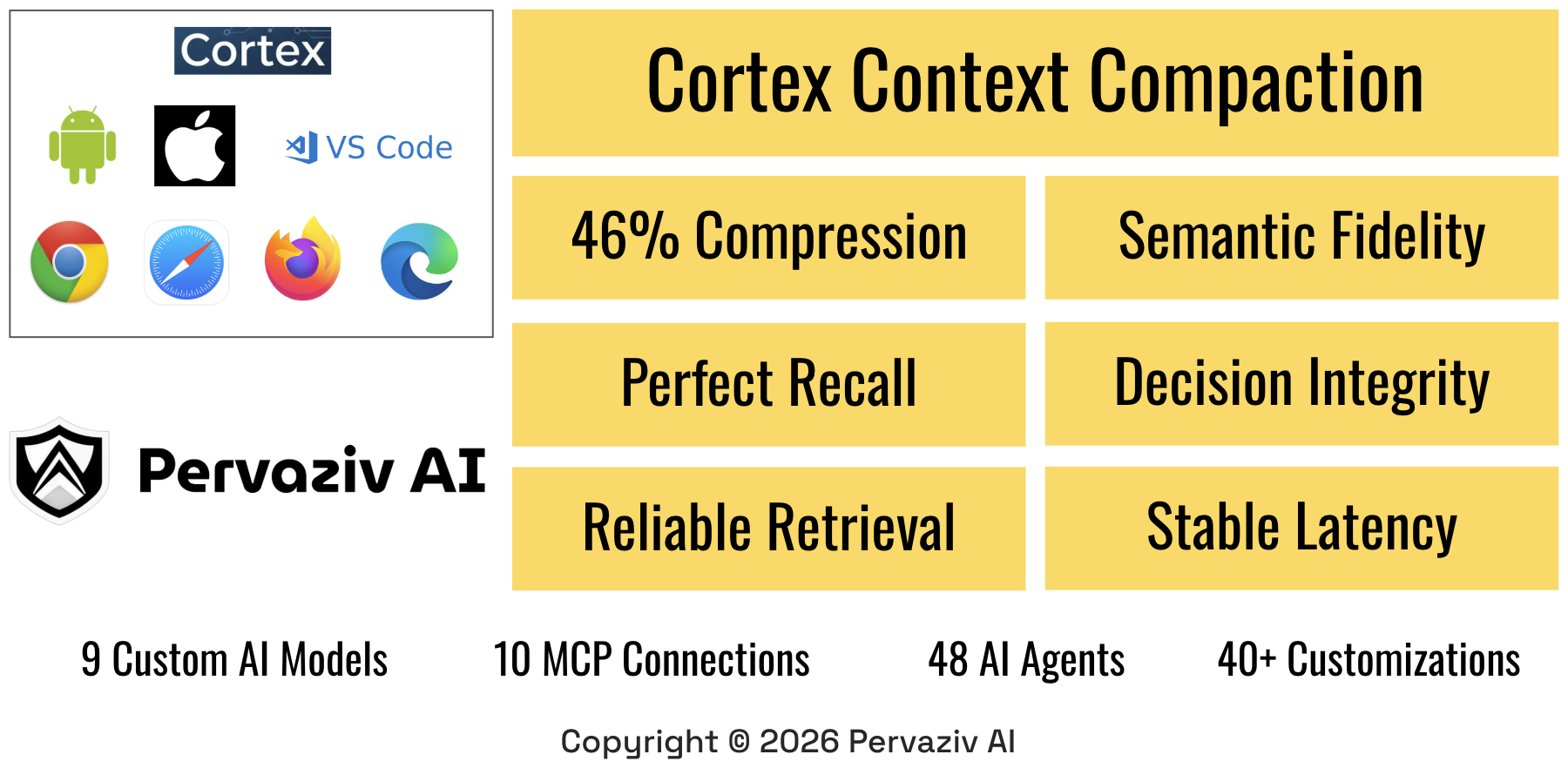
Cortex cuts eligible supplemental context by 46% while preserving required facts, retrieval, task success and validation across complex AI workflows.
SAN FRANCISCO, CA, UNITED STATES, September 4, 2026 /EINPresswire.com/ — Pervaziv AI today announced semantic context compaction in Cortex, introducing a new reliability layer designed to help AI remain aligned as work expands across long conversations, large files, tool results, changing decisions and multi step workflows.
The capability advances a broader Cortex architecture built around specialization and coordination. The Cortex AI Model Ensemble established distinct intelligence for different responsibilities. Cortex Router created an intelligent entry point for directing work. The expanded Cortex Routing Architecture added Search Router and Skill Router to connect requests with current information and relevant engineering practices. Context compaction now addresses a different system level challenge: how to preserve what matters when the amount of accumulated context begins to compete with the work that still needs to be done.
For enterprises, this challenge becomes increasingly important as AI moves beyond isolated questions and short coding interactions. Real work may span a design discussion, a repository investigation, implementation, security review, testing, validation, documentation and follow up decisions. Each step can add requirements, attachments, code, paths, logs, findings, tool output and conversational history.
More context does not automatically mean better context.
If every historical detail remains in full, prompts can become increasingly expensive and difficult to manage. If older material is removed too aggressively, the system can lose requirements, confuse identifiers, revive an obsolete decision or attempt to reconstruct information that should have been retrieved from an authoritative source.
Cortex semantic compaction is designed to operate between those two extremes.
## A New Reliability Layer for Long Running AI Work
———————————————————————–
The objective of context compaction is not simply to shorten a prompt. It is to distinguish information that determines correctness from information that no longer needs to remain fully represented.
Cortex can reduce lower value supplemental history while protecting current customer instructions, explicit constraints, active decisions, exact identifiers, recent conversation, safety information and references to authoritative sources.
That distinction matters because long running workflows create several predictable failure modes. Requirements can become buried under repetitive discussion. Earlier decisions can conflict with newer instructions. Similar file names and technical identifiers can be confused. Large attachments and tool outputs can consume substantial context. Generic summaries can omit essential details or introduce claims that were never supported.
The result can be an AI system that appears conversationally fluent while becoming less dependable as the interaction grows.
Cortex is designed to treat context as an actively managed part of the system rather than an unlimited transcript.
## 46% Less Eligible Supplemental Context
———————————————————-
Across the evaluated semantic compaction benchmark scenarios, the workload contained 192,776 characters of supplemental context eligible for compaction. After compaction, 103,384 characters remained.
That represents a 46% reduction in eligible supplemental context and 89,392 fewer retained characters.
Compaction activated only when the workload exceeded its configured threshold. The measurement applies specifically to context that was eligible to be compacted. Current instructions, protected facts, recent conversation, safety information and references to authoritative sources remained available.
The distinction is important. Pervaziv AI is not claiming 46% fewer total model tokens. Whole turn input can also include structured safeguards, retrieval references and protected context required to preserve correctness.
In the benchmark comparison, total model input increased by approximately 3%, even while eligible supplemental context decreased by 46%. The system used a small amount of additional structured context to support safer context management while removing substantially more lower value historical material.
For customers, the practical value is additional room for current instructions, new files, fresh validation evidence and future conversation turns.
## Preserving the Facts That Govern the Outcome
——————————————————————-
Context reduction is useful only if the AI still understands what the user asked it to do.
A smaller prompt is not an improvement if the system forgets a constraint, modifies the wrong file, restores a decision the customer already reversed or invents details from a source that is no longer present.
The Cortex benchmark therefore evaluated semantic fidelity alongside reduction.
Test scenarios included exact facts that had to remain available, similar technical identifiers, precise file paths and configuration values, decisions that were later reversed, large retrievable sources, irrelevant conversational padding, untrusted prompt like content and recall questions after compaction occurred.
Across those scenarios, Cortex recorded 100% required fact recall, zero unsupported facts, zero contradictions, zero stale decisions and zero protected fact losses.
The benchmark is designed around a simple principle: memory should assist the current task, but it should not become more authoritative than the customer’s latest valid instruction.
That means compacted memory can support continuity while protected context retains priority.
## Retrieval Instead of Reconstruction
—————————————————-
Large files and tool results present another challenge.
A source code repository, technical specification, build log, security report or compliance record may contain information that remains relevant across a workflow, but carrying the entire source in every subsequent request can consume context needed for new work.
Removing that material without preserving access creates a different risk. The system may attempt to recreate missing information from memory.
Cortex takes a retrieval first approach for authoritative source material.
The system can retain awareness of a source and retrieve it again when exact information is needed, rather than treating a compacted summary as a substitute for the original evidence.
Across the evaluated retrieval scenarios, Cortex achieved 100% retrieval success.
This design is particularly relevant for engineering and enterprise workflows involving repositories, technical specifications, large documents, build and test logs, security evidence, compliance records, data exports and extended tool output.
The goal is continuity without pretending that every source must remain in full inside every model request.
## Respecting Decisions That Change
—————————————————-
Enterprise work is rarely static.
Teams revise requirements, change implementation approaches, rename files, move deployment targets, update acceptance criteria and reverse decisions as new information becomes available.
Long context makes these changes harder to manage because older decisions remain present alongside newer ones. Weak summarization can merge conflicting choices or preserve both as active.
Cortex compaction is designed to preserve the newest valid decision and prevent superseded choices from resurfacing as if they still govern the task.
The benchmark explicitly evaluated decision reversal and recorded zero stale decisions and zero contradictions.
For customers, this can reduce the need to repeatedly restate the latest version of a requirement simply because the conversation has become long.
## Maintaining Task and Validation Quality
———————————————————
Context efficiency has little value if it degrades execution.
Across the evaluated workflow, Cortex maintained 100% task success and 100% validation success. The evaluation also recorded zero context overflow errors and zero fallback events.
These results indicate that the information necessary to complete the evaluated tasks and satisfy their validation requirements remained available after compaction.
That is especially important as AI assisted work becomes more agentic. A workflow may span investigation, planning, code changes, testing, security checks and validation. Context management must support the entire sequence rather than optimize one isolated model response.
No Observed Foreground Latency Regression
Context management also has to remain practical in the user experience. In the benchmark, median foreground latency changed from 2.60 seconds to 2.58 seconds. The 95th percentile changed from 4.35 seconds to 4.31 seconds.
Pervaziv AI interprets those measurements as stable foreground performance rather than a material speed improvement.
The customer facing result is that the evaluated context reduction introduced no observed foreground latency regression.
## From Model Intelligence to System Reliability
—————————————————————–
The announcement follows a series of Cortex releases that have progressively separated major AI responsibilities into coordinated system layers.
The Cortex AI Model Ensemble introduced specialized intelligence rather than relying on one general model for every task. Cortex Router added an intelligent coordination point for user intent. Search Router and Skill Router extended routing across current public information and engineering practices.
Context compaction adds another dimension: maintaining a dependable working memory as those capabilities operate over longer periods of time.
Together, these layers reflect a shift in how Pervaziv AI approaches Enterprise AI.
Model quality remains essential, but reliable AI also depends on what the system remembers, what it protects, what it retrieves, what it discards, which intelligence participates and how changing customer intent is carried forward.
“AI reliability is increasingly a context problem, not only a model problem,” said Anoop Jaishankar, Founder and CEO of Pervaziv AI. “The question is no longer just whether an AI can generate a good answer. It is whether the system can carry the right facts, decisions and evidence through a long workflow without letting old noise become new mistakes. Cortex compaction is designed to preserve what governs the outcome, retrieve what must remain authoritative, and make room for the work that comes next.”
Jaishankar continued, “As Enterprise AI moves into real operational workflows, context becomes part of the control plane. What the system remembers, what it is allowed to compress, which decision remains current and when it must return to an authoritative source can directly affect the quality of the outcome. We are building Cortex so those responsibilities are explicit system behaviors, not assumptions left to a single model.”
## Operational Visibility for Enterprise AI
——————————————————-
Reliable context management also needs to be measurable.
Organizations need visibility into when context was reduced, whether required information remained available, whether authoritative retrieval succeeded, whether stale decisions reappeared and whether the system fell back because context management failed.
The Cortex benchmark evaluates signals including compaction activation, eligible context before and after compaction, required fact recall, retrieval success, protected context retention, contradiction detection, stale decision detection, unsupported fact detection, fallback activity, context overflow rates and foreground latency.
These measurements are intended to provide operational visibility into system behavior without requiring raw customer content to appear in reporting.
That makes context management not only a model optimization problem, but also a reliability and governance discipline.
## What Customers Gain
———————————-
For customers, semantic compaction creates a foundation for larger and longer running AI workflows without treating every prior token as equally valuable.
The benefits include stronger continuity across extended conversations, more room for current instructions and new work, better handling of large files and tool results, lower risk of obsolete decisions resurfacing, more dependable recall of constraints and identifiers, safer use of retrievable source material, reduced context pressure and stable foreground performance.
The broader objective is to make AI useful beyond the first answer.
As Cortex coordinates specialized models, routing, planning, search, skills, security controls and validation, context compaction helps preserve the connective tissue between those capabilities. It gives the system a way to carry forward the facts and decisions that still matter while reducing material that no longer deserves full representation.
Across the evaluated semantic compaction scenarios, Cortex delivered a 46% reduction in eligible supplemental context, 100% task success, 100% validation success, 100% required fact recall, 100% retrieval success, zero unsupported facts, zero contradictions, zero stale decisions, zero protected fact losses, zero context overflow errors, zero fallback events and no observed foreground latency regression.
Pervaziv AI views this as another step toward a more durable Enterprise AI Control Layer, one designed not only to choose capable intelligence, but to preserve continuity, evidence and customer intent as AI work becomes longer, richer and more consequential.
## About Pervaziv AI
—————————–
Pervaziv AI is an Enterprise AI and cybersecurity company building Cortex, an AI platform designed to help organizations build, secure and operate software with specialized intelligence, agentic workflows, privacy controls, security analysis, validation and connected enterprise context.
Cortex brings AI into the environments where modern work already happens, spanning developer tools, browsers, mobile experiences and connected enterprise systems. Its architecture combines specialized models, routing, planning, privacy protection, prompt security, software security analysis, verification, search, engineering skills and workflow controls within a broader model independent platform strategy.
Pervaziv AI is focused on making advanced AI more practical for organizations that need capability, security, continuity and governance to work together. Rather than treating a model response as the complete product, Cortex is designed as a coordinated system in which intelligence, context, evidence, controls and human oversight can each play a defined role.
For more information, visit Pervaziv AI and the Cortex product newsroom.
Pervaziv AI
Pervaziv AI
email us here
Visit us on social media:
LinkedIn
Instagram
YouTube
X
Other
Legal Disclaimer:
EIN Presswire provides this news content “as is” without warranty of any kind. We do not accept any responsibility or liability
for the accuracy, content, images, videos, licenses, completeness, legality, or reliability of the information contained in this
article. If you have any complaints or copyright issues related to this article, kindly contact the author above.

Media gallery