
Birkdale Physio Clinic Explains Why Shoulder Rest Often Fails
Birkdale, Australia – July 7, 2026 / Essential Health Physiotherapy Birkdale /
Understanding Shoulder Pain That Won’t Go Away
Essential Health Physio, a physiotherapy clinic serving Birkdale and surrounding suburbs, has published a new blog article addressing one of the most common complaints seen in clinic: shoulder pain that won’t settle with rest. The article explains why persistent rotator cuff–related shoulder pain often persists despite weeks of taking it easy, and outlines the underlying reasons passive recovery tends to fall short. It breaks down what’s actually happening in the shoulder’s muscles and tendons, why prolonged inactivity can lead to further complications, and what a structured recovery plan generally entails. Written with input from the clinic’s physiotherapy team, the resource aims to help local adults, including office workers, tradespeople and weekend athletes, better understand their symptoms. Anyone researching Rotator Cuff Physio Birkdale will find the article a practical starting point for understanding their options.
What Effective Shoulder Physiotherapy Actually Involves
If your shoulder has been aching for weeks and resting it hasn’t made a dent, you’re not imagining things. Persistent rotator cuff–related shoulder pain is one of the most common reasons people in Birkdale book in with a physiotherapist, and the research is fairly clear on one point: rest alone is rarely the answer.
What follows is a breakdown of what’s actually happening with rotator cuff injuries, why passive recovery so often falls short, and what a proper physiotherapy plan tends to involve.
What Is Rotator Cuff–Related Shoulder Pain?
The term “rotator cuff injury” covers more ground than most people realise. It’s an umbrella diagnosis that includes subacromial pain syndrome, rotator cuff tendinopathy, subacromial bursopathy, long head of biceps tendinopathy, and partial-thickness rotator cuff tears. Each condition has slightly different characteristics, but they share a common thread: the shoulder’s intricate system of muscles and tendons isn’t functioning the way it should.
For adults working desk jobs in Birkdale, the issue often starts quietly. Prolonged computer work gradually shifts posture, places uneven load on the shoulder, and reduces the range of movement the rotator cuff regularly moves through. The first sign is usually achiness after a long day. Then it starts interrupting sleep.
For manual workers and gym-goers, the pattern looks different. Repetitive overhead movements, sudden increases in training load, or sustained work at awkward heights can tip a tendon from manageable to painful with relatively little warning.
Why Resting Your Shoulder Tends to Backfire
Rest has a place in the very early, acute stage of shoulder pain. If there’s significant inflammation, taking load off the shoulder for a few days is reasonable. The problem is that extended rest creates its own set of complications.
Tendons respond to load. When a tendon is unloaded for too long, it doesn’t simply recover and wait. It becomes more sensitive to pain, loses capacity, and is more prone to flaring up the moment normal activity resumes. This explains the cycle many people describe: rest for two weeks, feel better, return to the gym or a heavy day at work, and have the shoulder give out again.
Muscle weakness and imbalance also worsen with inactivity. The rotator cuff depends on a network of muscles, including the scapular stabilisers, to distribute load through the shoulder correctly. Time off doesn’t restore this balance. Targeted loading does.
Movement patterns that may have contributed to the injury in the first place remain unchanged when the shoulder is simply rested. Without addressing posture, technique, or load management, the same mechanical stress returns to the same tissues once activity picks back up.
What Rotator Cuff Physiotherapy Actually Involves
A physiotherapy plan for rotator cuff–related shoulder pain usually starts with load management rather than avoidance. The goal is to identify which activities are currently aggravating the shoulder and adjust them to a level the tendon can tolerate without flaring. This is specific to each person and changes as the shoulder improves.
Progressive strengthening follows. Early-stage exercises target the rotator cuff muscles, then gradually bring in the scapular musculature surrounding the shoulder blade. The aim is to restore both strength and coordination. Closed kinetic chain upper body stability exercises are commonly introduced as capacity builds, always guided by how the tendon is responding.
Manual therapy can help manage pain and address any joint stiffness contributing to the problem. Stiffness in the shoulder joint changes how it moves and can shift load onto the tendons during routine tasks.
Dry needling is another tool that has shown benefit in this area. A 2025 study published in the Journal of Hand Therapy found that dry needling of rotator cuff trigger points can improve shoulder stability, grip strength, and pain levels when paired with progressive strengthening exercises (Ghasemi et al., 2025). It works by targeting trigger points and activating muscle groups that have become underactive, which often contributes to the imbalances driving shoulder pain.
Patient education rounds out the plan. Understanding how tendons work, why flare-ups occur, and how to manage load appropriately gives people practical tools to maintain progress outside of appointments and prevent the same problem from recurring.
Adjusting the Approach for Different Work and Lifestyles
Office workers in Birkdale often benefit from workstation review as part of their physiotherapy plan. Desk height should ideally allow elbows to rest at roughly 90 degrees during typing. Keeping the mouse close to the keyboard reduces the overreaching that quietly loads the shoulder across a full workday. These adjustments don’t fix a rotator cuff injury on their own, but they remove a consistent source of strain that makes recovery harder.
Many Birkdale residents combine sedentary weekdays with active weekends: kayaking, paddleboarding, overhead sport, and weekend sport with the kids. This pattern is worth flagging because the shoulder muscles may not maintain the capacity to handle sudden increases in demand. A physio-guided strengthening programme helps bridge that gap. For manual workers whose jobs involve repetitive overhead or across-body movements, sports injury physiotherapy principles often apply well, with the focus on building enough shoulder capacity to meet work demands without aggravating the tendon.
For gym-goers, the priority is identifying which movements are currently aggravating the tendon and which aren’t loading it adequately. Complete rest from training is rarely necessary. Most people can continue modified training throughout recovery, with specific exercises replaced or scaled and technique reviewed by a physiotherapist.
When Conservative Treatment May Not Be Enough
Not every rotator cuff presentation responds to physiotherapy alone. If a significant structural tear is present, if the shoulder has been unresponsive to a well-structured programme over several months, or if there are other drivers behind the pain, imaging and a specialist opinion may be worth pursuing.
This is the exception rather than the rule. Research supports physiotherapy as the primary treatment for most rotator cuff–related shoulder pain when the assessment is thorough and the programme is progressed appropriately. The difficulty is that many people either rest indefinitely, begin a generic exercise routine without clinical guidance, or return to full activity too early. Each of these tends to extend recovery time.
Rotator Cuff Shoulder Pain: Your Questions Answered
| Question | Answer |
|---|---|
| What is rotator cuff-related shoulder pain? | Rotator cuff-related shoulder pain is an umbrella term covering several conditions, including subacromial pain syndrome, rotator cuff tendinopathy, subacromial bursopathy, long head of biceps tendinopathy, and partial-thickness rotator cuff tears. Each involves dysfunction of the shoulder’s muscles and tendons. |
| Why doesn’t rest fix a rotator cuff injury? | Rest addresses early inflammation but doesn’t resolve the underlying issues, which commonly include muscle weakness, tendon sensitivity, and poor movement patterns. Tendons need graduated loading to recover capacity. Extended rest often increases pain sensitivity and leaves the shoulder prone to re-injury. |
| What does rotator cuff physiotherapy involve in Birkdale? | Rotator cuff physiotherapy typically includes load management, progressive strengthening of the rotator cuff and scapular muscles, manual therapy for joint stiffness, and patient education. Dry needling may also be used to reactivate underactive muscle groups. |
| Can I keep training at the gym with a rotator cuff injury? | In most cases, yes. A physiotherapist can identify which exercises aggravate the tendon and which are safe to continue or modify. Complete rest from training is rarely necessary, and modified training often supports recovery better than stopping altogether. |
| How long does recovery from a rotator cuff injury take with physiotherapy? | Recovery varies depending on the type and severity of the rotator cuff condition, how long symptoms have been present, and how consistently the rehabilitation programme is followed. A physiotherapist can provide a clearer indication after an initial assessment. |
Taking the Next Step for Persistent Shoulder Pain in Birkdale
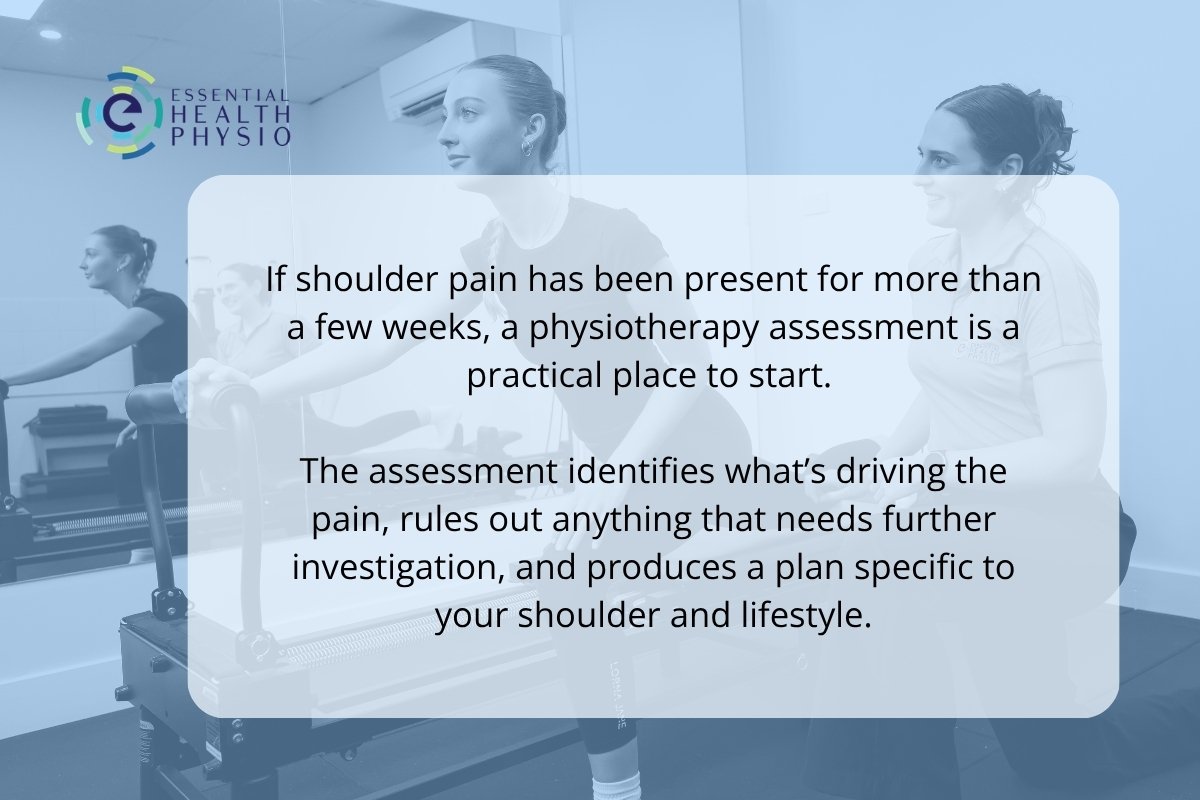
If shoulder pain has been present for more than a few weeks, a physiotherapy assessment is a practical place to start. The assessment identifies what’s driving the pain, rules out anything that needs further investigation, and produces a plan specific to your shoulder and lifestyle. Essential Health Physio’s Birkdale clinic works with adults across the Redlands area for musculoskeletal conditions including rotator cuff–related shoulder pain.
Essential Health Physio Supports Shoulder Recovery
 Birkdale is a leafy Redlands suburb of Brisbane known for its bayside charm. Essential Health Physio offers physiotherapy here and across surrounding suburbs.
Shoulder pain that lingers past a few weeks is worth having properly assessed rather than left to resolve on its own. Essential Health Physio’s Birkdale clinic works with adults across the Redlands area to identify what’s driving persistent shoulder symptoms and to build a recovery plan suited to individual lifestyles and work demands. Readers dealing with ongoing discomfort, or anyone searching for support with Rotator Cuff Injury Physio Birkdale, are encouraged to reach out to the friendly team at Essential Health Physio for a consultation and further information on the full article, “Rotator Cuff Physiotherapy Birkdale: Why Rest Alone Isn’t Enough and What to Do Instead.”


Contact Information:
Essential Health Physiotherapy Birkdale
Shop 20a/120 Birkdale Rd
Birkdale, QLD 4159
Australia
Johnson Kwan
https://essentialhealthphysio.com.au/


Original Source: https://essentialhealthphysio.com.au/rotator-cuff-physiotherapy-birkdale/


