NANJING, CHINA, July 7, 2026 /EINPresswire.com/ — The landscape of modern firefighting and emergency rescue has undergone a profound transformation over the past decade, driven by rapid advancements in microelectronics, sensor fusion, and wireless communication. In hazardous environments where dense smoke, toxic gases, and extreme thermal radiation severely compromise human senses, the reliability of personal protective equipment is the thin line between a successful rescue operation and a catastrophic casualty. Among the most critical assets deployed in these environments is the Personal Alert Safety System (PASS), a device traditionally designed to emit audible and visual alarms when a firefighter becomes immobilized or distressed. As global safety standards elevate, municipal fire departments and industrial emergency response units increasingly seek comprehensive, integrated solutions rather than isolated, single-purpose gadgets.
At the forefront of this technological shift is ZHENGZE,one of Top 10 Suppliers of PASS Device Firefighter, legally known as Nanjing ZHENGZE Technology Co., Ltd. Established in March 2004, the enterprise has dedicated over two decades to the intensive research, development, and manufacturing of intelligent emergency rescue apparatus. By positioning itself not merely as an assembly vendor but as an original equipment manufacturer (OEM) with vertical integration capabilities, the company has grown into a dominant force in the Chinese domestic market and an emerging benchmark internationally. Operating from a state-of-the-art production facility spanning more than 5,000 square meters and supported by a highly specialized workforce of over 200 professionals, the company maintains a robust research and development division that has successfully secured more than 100 core patents. This profound engineering foundation enables the organization to provide end-to-end bespoke solutions, ranging from custom functional architecture and structural component design to mold production and global certification workflows. Their holistic product system spans high-end emergency rescue gear, resilient emergency communication nodes, and intelligent personal protection systems, all engineered to withstand the most punishing operational realities.
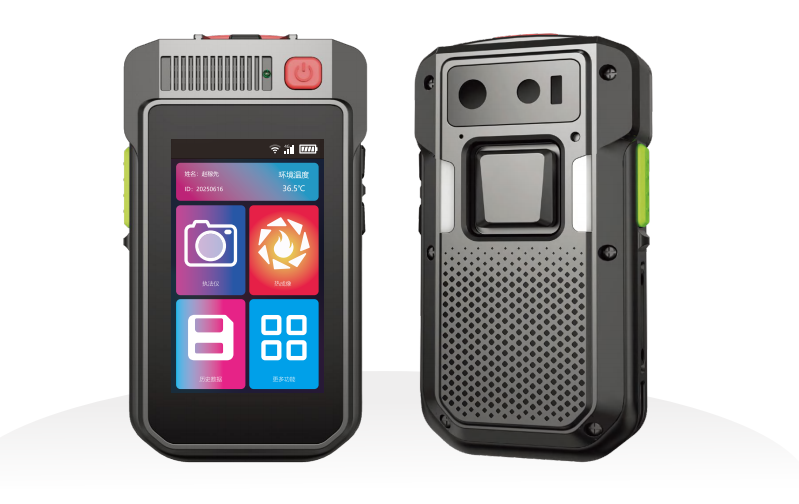
RHJ800/TS Intelligent Thermal Imaging Rescue Device for Individual Firefighters
The RHJ800/TS Intelligent Thermal Imaging Rescue Equipment is an innovative, multi-functional rescue tool for individual firefighters. Building upon the core safety mechanisms of traditional firefighter pass devices, it deeply integrates cutting-edge technologies such as infrared thermal imaging, visible light optics, wireless communication, and precise positioning. This equipment aims to address the pain points faced by firefighters in extreme fire environments such as darkness, dense smoke, and toxic gases, including visual loss, disorientation, and communication interruptions, comprehensively improving on-site rescue efficiency and ensuring the safety of rescue personnel.
The following are the overall core functions and technical features of this equipment:
I. The Evolution of Structural Integration in First Responder Telemetry
For decades, firefighters have entered burning structures burdened by a fragmented array of standalone devices: a thermal camera slung over the shoulder, a handheld radio clutched in a heavy glove, a separate PASS device clipped to the self-contained breathing apparatus (SCBA) harness, and a mechanical compass vulnerable to magnetic interference. This hardware proliferation not only increases the physical load on the responder but also induces cognitive overload during critical, high-stress decision-making moments. Recognizing this systemic flaw, engineering paradigms have shifted toward comprehensive hardware consolidation. The objective is to merge multiple life-saving modules into a single, cohesive, ultra-rugged handheld chassis that serves as an information hub for both the individual operator and the remote incident command center.
The realization of this integrated paradigm is exemplified by the RHJ800/TS Intelligent Thermal Imaging Rescue Device for Individual Firefighters. This innovative equipment represents a significant evolutionary leap beyond legacy distress signal apparatus. Built upon the foundational safety mechanics of a traditional PASS device, the system integrates infrared thermal imaging, visible light imaging, real-time on-site video recording, push-to-talk (PTT) voice communication, Bluetooth connectivity, digital compass orientation, auxiliary LED illumination, and dual-mode satellite and inertial indoor-outdoor positioning. By consolidating these disparate subsystems into a unified device, operators no longer need to manage multiple battery formats or fumble with distinct interfaces in zero-visibility conditions. The unified structural layout ensures that critical life-safety metrics and environmental observation tools are continuously accessible through a single, ergonomically optimized device, fundamentally altering how personnel interact with their protective gear.
II. Advanced Thermal Imaging and Multi-Mode Optical Diagnostics
In structural fires, dense particulate matter and soot completely block the visible light spectrum, rendering standard human vision useless. Infrared thermal imaging bypasses this visual barrier by detecting long-wave infrared radiation emitted by objects based on their surface temperature differentials. The RHJ800/TS incorporates a high-performance uncooled focal plane array sensor that delivers clear thermal rendering alongside visible light optics. This dual-lens design allows the system to support multiple advanced image visualization modes tailored to rapidly changing tactical situations. First responders can seamlessly cycle through four distinct visual display profiles: Full-Color Mode, Hotspot Mode, White-Hot Mode, and Black-Hot Mode.
Each processing mode serves a precise operational purpose. Full-Color Mode delivers a highly detailed color gradient map of the environment, ideal for structural assessments and identifying hidden fire perimeters behind walls. Hotspot Mode isolates and highlights the highest thermal signatures within the field of view, allowing rescue teams to quickly locate hidden victims, downed teammates, or localized flashover points through dense smoke layers. White-Hot and Black-Hot Modes provide high-contrast monochrome representations that excel in detecting minute structural variations, exits, and obstacles. Furthermore, the device integrates intelligent infrared thermometry algorithms capable of automatic temperature tracking. The software automatically captures high and low temperature fluctuations across the frame and calculates real-time center-point temperature measurements up to extreme levels. This real-time thermography data is rendered dynamically on a built-in 3.1-inch high-resolution color display, providing immediate quantitative clarity regarding the environmental thermal threat. To preserve critical evidence and facilitate post-incident analysis, the unit features integrated photography and video recording functionalities, enabling the capture, playback, and seamless digital transmission of live tactical feeds directly from the interior of the hazard zone.
III. Robust Life-Safety Alarms and Environmental Intelligence
The core life-safety mechanism of any PASS device relies on its automated distress detection system, and the RHJ800/TS implements a multi-tiered, sensor-driven alarm architecture designed to eliminate false negatives while ensuring instant notification during true emergencies. The device features an integrated tri-axial accelerometer that monitors the physical movement of the firefighter. If an operator becomes immobilized—whether due to structural collapse, medical emergency, or blast disorientation—the system initiates a calibrated countdown protocol. If no motion is detected for a continuous duration of 30 seconds, the unit enters a pre-alarm state, emitting a localized warning tone and activating subtle visual indicators to alert the wearer to shift position if they are conscious. If the immobilization persists for a total of 45 seconds, the system escalates into a full-scale high-intensity alarm. This state activates a high-decibel acoustic siren paired with high-brightness red LED directional strobe lights, ensuring that search-and-rescue teams can locate the downed responder through absolute darkness and dense acoustic clutter. For immediate manual escalation, a prominent, easily accessible SOS button can be held down to trigger the emergency alarm state instantly.
Beyond kinetic tracking, the device acts as an environmental intelligence node by integrating ambient temperature monitoring sensors. Firefighters operating in close proximity to a blaze are susceptible to rapid thermal exhaustion or sudden exposure to convective superheated gas layers. The internal telemetry system continuously reads external ambient temperatures and displays them prominently on the user interface. Crucially, the firmware includes a safety threshold trigger: if the external ambient temperature exceeds 80 degrees Celsius, the device automatically activates an audible and visual thermal warning alarm. This proactive alert provides the firefighter with a clear window of time to retreat before structural gear failure occurs or thermal injuries are sustained. Additionally, the high-brightness red directional orientation lights serve a dual purpose, functioning as a beacon for trailing team members navigating through heavy smoke, thereby maintaining squad cohesion in chaotic layouts.
IV. Seamless Wireless Interoperability and Ecosystem Connectivity
Modern emergency rescue cannot occur in isolation; it depends entirely on the fluid exchange of data across an interconnected network of personnel, equipment, and command centers. The inclusion of a robust Bluetooth communication module within the RHJ800/TS elevates it from a standalone handheld tool into a central gateway for personal area network (PAN) telemetry. Through low-latency Bluetooth pairing, the device establishes real-time bi-directional data links with an array of critical auxiliary peripheral equipment worn by the responder. This includes interfacing with smart biometric wristbands to track real-time heart rate variability, linking with wearable Heads-Up Displays (HUD) mounted inside the SCBA facepiece to project thermal data directly into the user’s line of sight, and connecting with digital portable gas detectors.
A prime example of this ecosystem integration is the system’s seamless pairing with intelligent breathing apparatus control modules, often referred to as smart SCBA back-frames. By linking directly with the breathing system, the device can aggregate cylinder pressure data, residual air volume metrics, and consumption rates, displaying these parameters alongside the primary navigation and thermal screens. Similarly, the connection to external toxic and combustible gas monitors ensures that if gas concentrations cross permissible thresholds, the warning is aggregated and displayed immediately on the 3.1-inch color screen. This hardware-level and protocol-level compatibility ensures that all vital personal and environmental statistics are funneled through a single interface, minimizing the need for multiple screens and allowing the responder to maintain a unified focus on the immediate environment and mission objectives.
V. Cloud-Enabled Data Transmission and Black Box Survivability
The ultimate layer of operational safety is achieved by bridging the gap between the frontline hazard environment and the remote command post. The RHJ800/TS achieves this through an integrated high-speed 4G public cellular network module, supported by hot-swappable SIM card deployment. This cellular architecture enables real-time cloud-based scheduling and data transmission. Frontline audio communication, full-motion thermal video feeds, and spatial coordinate data are streamed via 4G telemetry through a secure cloud dispatch server directly to both localized mobile command units and distant regional headquarters. This real-time data streaming allows incident commanders to see exactly what the entry team sees, facilitating precise tactical decisions, resource allocation, and proactive rescue deployments. Voice communications are further enhanced by an ergonomic PTT (Push-To-Talk) button mounted on the lateral face of the rugged housing, designed for flawless operation even when wearing heavy, layered structure gloves.
Equally critical is the post-incident accountability data loop, which is managed by the device’s integrated Black Box functionality. Operating similarly to aviation flight data recorders, this internal storage partition automatically logs all operational parameters, sensor histories, temperature fluctuations, alarm triggers, and voice transmissions in a non-volatile, hardened storage medium. This data cache cannot be overwritten or altered by the user, providing a pristine digital timeline for post-incident analysis, training reviews, and forensic investigation. To ensure that this sophisticated electronic suite survives the absolute extremes of a fire ground, the physical housing is constructed from high-impact, flame-retardant polymers engineered to meet IP68 ingress protection standards. This certification guarantees complete immunity to microscopic dust penetration and ensures continuous, uncompromised submerged operation in deep water, securing total system survivability when subjected to high-pressure fire hoses or accidental flash flooding within subterranean structures.
For technical inquiries, product specifications, or procurement consultations regarding advanced rescue apparatus, please visit the company’s official web presence at https://www.zhengzesafety.com/
Nanjing Zhengze Technology Co., Ltd.
Nanjing Zhengze Technology Co., Ltd.
email us here
Legal Disclaimer:
EIN Presswire provides this news content “as is” without warranty of any kind. We do not accept any responsibility or liability
for the accuracy, content, images, videos, licenses, completeness, legality, or reliability of the information contained in this
article. If you have any complaints or copyright issues related to this article, kindly contact the author above.

Media gallery