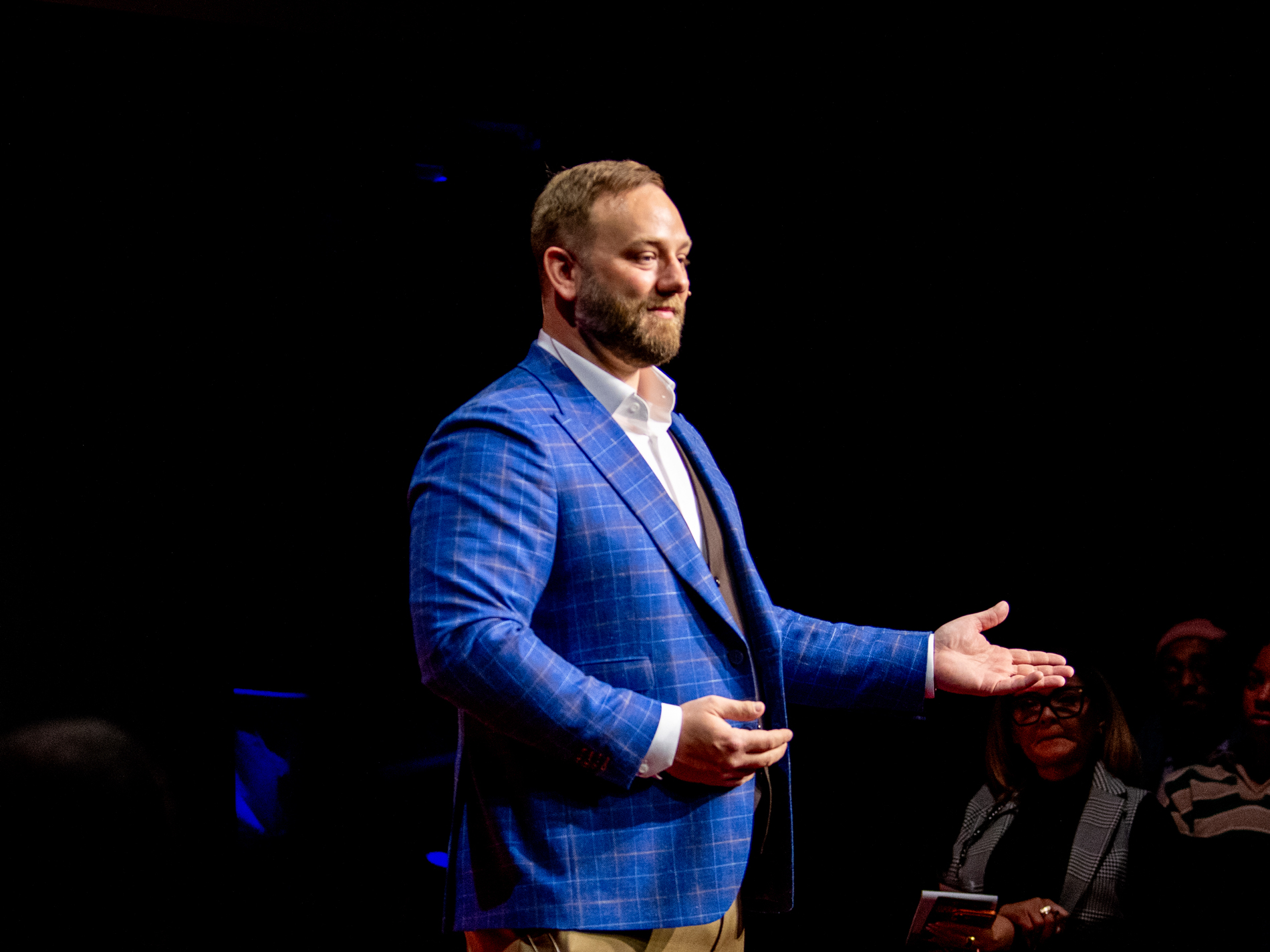
Phil Neil of Founders Compass calls uncertainty, fear, and unworthiness the Shadow of Entrepreneurship and offers Calm, Clarify, Commit as the solution
MONTREAL, QUéBEC, CANADA, May 25, 2026 /EINPresswire.com/ — Phil Neil, founder of Founders Compass, gave a TEDx talk at TEDxHarvard Square titled “When Founders Break, Businesses Follow.”
The argument: most startup failures come from how the founder handles inner pressure, not from a bad market or a bad product. They begin with how the founder handles inner pressure. Phil calls that the Shadow of Entrepreneurship: three emotions, uncertainty, fear, and unworthiness, that amplify noise and make founders reactive.
When that Shadow goes unseen, it creates a pressure cascade that moves through partners, employees, investors, and loved ones, eventually multiplying back onto the founder. His proposed response is an inner operating system built on three steps: Calm, Clarify, and Commit.
Phil Neil’s own story sets it up. In 2021, he sold a business he had scaled from a few hundred thousand dollars to more than 70 million in revenue in under eight months. On paper, a clean win. Then the call came. The warehouse holding the inventory tied to part of his original exit payout had burned. The stock was not insured. Phil Neil says he crashed into depression.
Recovery started with what Phil Neil calls permission. Permission to let the world burn. He suggests entrepreneurs stop fighting every fire and let the world burn for a while. For him, the permission to let the world burn allowed him to take his three children, then three, five, and seven, to Cancun. Phil Neil calls the trip his anchor. The months after gave him room to look at the root causes of his own wins and failures.
Most startup failures, Phil Neil says, are misread as business problems, when the real issue is how the founder responds to pressure. Every year, millions of founders step into that role. In the U.S. alone, 5.2 million new business applications were filed in 2025. What is more concerning is that, in a survey of more than 400 startups, 72% said the pressure of entrepreneurship had hurt their health, and 81% said they never talk about it.
Phil Neil frames entrepreneurship as two games at once. The business game is products, strategy, and markets, where founders usually have plenty of help. The founder journey is the inner game that drives the decisions, and it mostly happens outside the founder’s comfort zone.
That is what pulls founders into what Phil calls the Shadow of Entrepreneurship: three emotions that keep visiting every founder, amplifying the noise and making them reactive to it.
Uncertainty says: I have to decide now.
Fear says: I have to act before it’s too late.
Unworthiness says: I have to prove that I’m enough.
Each of these emotions offers relief through reaction. But that is the trap: the relief feels like progress, but it is not. It is noise.
The problem is not that founders feel these emotions. The problem is when they do not see them, because then the emotions run the show. And when the Shadow runs the show, decision quality collapses, and the pressure does not stay inside one person.
Phil Neil uses his own breaking point as the example. Just as his new business seemed ready to take off, everything stopped. His partners, the technical brains behind the company’s technology and patent, burned out and quit. The lab went dark, customers moved on, and the hope around the breakthrough disappeared.
On paper, it did not make sense. But through the lens of what Phil calls the Shadow of Entrepreneurship, it did. For over a year, uncertainty, fear, and unworthiness had been chipping away at the team’s mental health and resilience. By the time the company finally pivoted toward what looked like strong product-market fit, his partners were already drained.
Phil says he should have paid more attention to their Shadow and been more open about his own, but by then it was too little, too late. Pressure had already cascaded through the system, reaching partners, employees, investors, and loved ones. As people carried pressure they did not know how to hold, they reacted in their own ways. Some withdrew. Some burned out. Some fought. Some quit.
And when stakeholders break, the pressure does not return to the founder incrementally. It multiplies. When Phil’s partners left, they did not only take their work with them. They took the innovation pipeline, investor credibility, customer confidence, stability, and hope their presence represented.
That is what makes the cascade so dangerous. It makes the founder’s own breaking point harder to see. And if it keeps going, the founder breaks. When founders break, businesses follow.
Phil Neil’s response is what he calls an inner operating system built to hold under pressure: Calm, Clarify, and Commit.
The goal is not to create a future where pressure disappears. Phil says that is not possible. The Shadow will visit every founder, every leader, and every team building something meaningful. The real question is whether founders keep doing what hustle culture trained them to do, reacting to every fire until the system breaks, or whether they build an inner operating system strong enough to stop the cascade before it begins.
Phil proposes an inner operating system called the 3C Protocol: Calm, Clarify, and Commit.
The first step is Calm. Founders should regulate themselves first, because they cannot think their way out of the Shadow. They need to breathe, find their anchors, and give themselves permission to let the world burn for a while. In the ashes of fake urgency, they can see what truly requires their attention.
The second step is Clarify. Founders should keep their finger on the pulse, name the Shadow, pull it out of key stakeholders regularly, and challenge its story. If the Shadow says they are about to lose everything, the question becomes: is that true, or is it just loud?
The third step is Commit. When a decision is required, founders should commit only to quality decisions and stay true to them when the Shadow tempts them with relief through change. The Shadow promises growth and relief if they react, but Phil calls that promise an empty lottery ticket that can cost both success and health.
He closes with the line that gives the framework its purpose: when growth shouts, trust the whisper. The future he points to is one where the founder’s inner operating system holds, so the founder does not break and the business does not follow.
Phil Neil’s full TEDxHarvard Square talk, “When Founders Break, Businesses Follow,” is available on YouTube.
About Founders Compass:
Founders Compass is a Canada-based advisory practice founded by Phil Neil, focused on founder performance and decision quality under pressure. The firm works with entrepreneurs on building what Phil Neil calls an inner operating system so that founder breakdowns do not cascade into business failures.
More at founderscompass.com
Bo FC
Founders Compass
email us here
Legal Disclaimer:
EIN Presswire provides this news content “as is” without warranty of any kind. We do not accept any responsibility or liability
for the accuracy, content, images, videos, licenses, completeness, legality, or reliability of the information contained in this
article. If you have any complaints or copyright issues related to this article, kindly contact the author above.

Media gallery