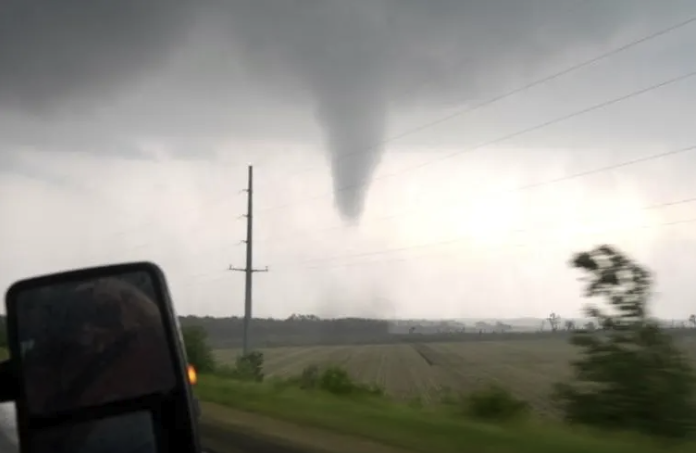
An air-cannon-launched probe completes multiple revolutions inside the Blue Rapids, Kansas tornado, producing the first ground-up 3D dataset of its kind.
NORMAN, OK, UNITED STATES, June 9, 2026 /EINPresswire.com/ — Team Dominator has released the first ground-up, three-dimensional dataset of wind and thermodynamic measurements ever recorded inside a tornado, a measurement that has eluded direct study for the modern history of atmospheric science. During the intercept of the Blue Rapids, Kansas tornado, a parachuted pseudo-Lagrangian drifter designed by engineer Will Clay was launched by air cannon from the armored Dominator 3, piloted by Dr. Reed Timmer with Matt Spatol navigating. The drifter completed at least three revolutions before sampling the updraft known as the “vent” between 6,000 and 10,000 feet, capturing a peak wind of 131 mph in the dynamic pipe and over 115 mph near the ground. Data streamed live to the team’s open platform, Domlabs.io.
A pseudo-Lagrangian drifter is an instrumented probe designed to flow with the medium it is measuring, allowing researchers to track changes within a moving air parcel rather than from a fixed external position.
The result is genuinely revolutionary. The dataset is the first to resolve the three-dimensional structure of a tornado’s dynamic pipe. The drifter streamed live data through the body of the storm while the Dominator 3 simultaneously measured surface winds, producing what Dr. Timmer describes as a “three-dimensional X-ray.” The dataset reveals a high swirl ratio tornado with two distinct pressure maxima and an unexpected airflow loop on the back side, a behavior not previously documented in the literature.
“It is the winds at ground level that cause loss of life and property. That is where the biggest mystery of tornado dynamics lies, and where direct measurement has been hardest. What we are now able to contribute is real interior wind data the broader community can use to refine our collective understanding of how tornadoes behave. This is more of a launch pad than an ending point.”
— Dr. Reed Timmer, Extreme Meteorologist, Team Dominator
For thirty years, the inner core of a tornado has been the grand unsolved problem of atmospheric science, and the surface wind, which matters most for public safety, has been the hardest measurement of all. Multi-vortex tornadoes can locally accelerate surface winds well beyond the parent vortex, producing intensities never directly measured. The Blue Rapids intercept is the first deployment to produce a continuous, real-time, 3D dataset from ground level through the vent above 6,000 feet.
The Blue Rapids tornado received an official EF1 rating. The Enhanced Fujita scale assigns ratings from post-storm damage surveys, which depend on damage indicators in the storm’s path. The probe data shows surface winds above the range typically associated with an EF1, the kind of direct interior measurement that could one day complement post-storm surveys with real-time observations.
The Blue Rapids drifter is still missing. Only a condensed subset of data was transmitted live; a fourth revolution is recoverable only from the onboard archive. The drifter was likely carried 30 to 40 miles northeast of its launch point, and Team Dominator asks the public to report sightings of a red parachute across northeastern Kansas via Domlabs.io.
“The mission is to better understand tornado intensity in real time. Our work is meant to complement existing methods, not replace them. We don’t gatekeep anything we collect. Every dataset goes up on Domlabs.io within minutes, open to researchers anywhere. We didn’t just measure a tornado. We made the measurement available.”
— Will Clay, Probe Designer, Team Dominator
The breakthrough lands as the United States approaches its 250th anniversary in July 2026. America has always been defined by people who refused to accept that something couldn’t be done. Franklin pulled lightning from the sky with a kite. The Wright brothers turned a bicycle shop into the airplane. NASA put twelve people on the Moon. That same restless instinct, carried by small teams, is what produced the first ground-up 3D dataset ever recorded inside a tornado, work the team intends to keep building toward the kind of breakthrough that earns a place in that American lineage. The 2026 storm season will field an expanded probe fleet targeting 15 to 25 intercepts, and the team is seeking research partners and funders. The work has a name, printed on merchandise from the team’s Norman, Oklahoma headquarters: Never Stop Chasing.
Will Clay
Team Dominator
will@willclay25.com
Visit us on social media:
LinkedIn
Instagram
Facebook
YouTube
TikTok
X
Other
Legal Disclaimer:
EIN Presswire provides this news content “as is” without warranty of any kind. We do not accept any responsibility or liability
for the accuracy, content, images, videos, licenses, completeness, legality, or reliability of the information contained in this
article. If you have any complaints or copyright issues related to this article, kindly contact the author above.

Media gallery