
Singapore – November 14, 2026 –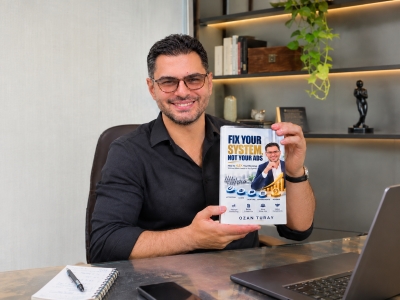
Imagine it is 10.30pm. You have finally left the shop, office or worksite. Your phone lights up again.
A customer wants a quotation. A staff member needs approval. Someone is asking whether an invoice has been paid. Tomorrow’s appointments have not been confirmed, and you still have messages from last week that you meant to answer.
You started your business to build something of your own. Somewhere along the way, you became the person everyone needs for everything.
Business is busy. You’re exhausted. Yet when you review the month, profits have barely moved.
For many SME owners, this is the uncomfortable side of entrepreneurship. They work harder, hire more people and take on more customers, but the business does not necessarily become easier to run.
Singaporean marketing strategist Ozan Turay believes the problem may not be a lack of effort. It may be that too much of the company still depends on its owner.
When Being Indispensable Becomes the Problem
Ozan is the co-founder of ACE Digital SG and author of Fix Your System, Not Your Ads. With more than nine years in digital marketing, branding and sales systems, he has helped generate over $30 million in reported client sales through projects he contributed to.
He has observed a pattern that many business owners will recognize.
A company gets an inquiry, but only the boss knows how to respond. A customer agrees to buy, but nobody knows who should send the invoice. A project is delayed, so the owner steps in to sort it out. The next day, it happens again.
Each problem seems small enough to handle. Together, they consume the day.
What looks like dedication can become a bottleneck. When every decision, customer question or follow-up needs the founder’s attention, the business can only move as fast as one person.
That creates a difficult choice. Work longer hours or accept that some opportunities will be missed.
Ozan argues there is a third option: design the business so routine work does not need the owner’s constant involvement.

The Lesson Ozan Learned in His Own Business
His perspective comes partly from personal experience.
In his book, Ozan describes a period when results rose or fell depending on how hard he pushed. When he followed up with customers, explained offers and handled sales calls personally, things moved. When he became distracted or tired, conversations slowed and opportunities slipped away.
He was doing plenty of work, but he could not rely on the results.
The turning point came when he stopped asking what else he needed to do and started asking which parts of the process needed to be fixed.
He made offers easier to understand, prepared prospects before sales calls and built clearer follow-up steps. Instead of treating every delayed reply as a reason to chase harder, he looked at what had made the customer hesitate in the first place.
Ozan writes that his workload eventually decreased as the process improved. More conversations progressed without him having to repeat the same explanation, and revenue became less dependent on whether he had a particularly productive day.
It was a change in how he ran the business, not simply how many hours he worked.
A Client Case Study: When the Team Is Busy but Opportunities Are Still Lost
Ozan gives another example in Fix Your System, Not Your Ads.
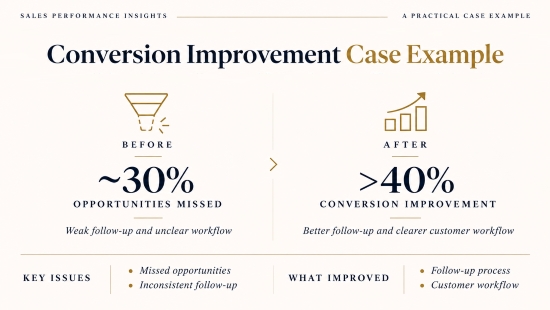
One business he worked with was receiving hundreds of leads a month. Its offer was compelling and it had established credibility, but it was still missing roughly 30% of opportunities.
The issue was not that employees were doing nothing. Follow-up was inconsistent, new customers sometimes encountered gaps during onboarding, and opportunities to offer additional services were overlooked.
In a busy SME, those failures are easy to understand. A salesperson assumes someone else has replied. A team member forgets to check an old inquiry. A new client signs up but waits too long to hear what happens next.
The business keeps operating, but potential revenue quietly disappears.
Rather than asking staff to remember more, Ozan says the team introduced automated lead nurturing, clearer onboarding and scheduled client follow-ups.
According to his account, conversions increased by more than 40%. He also reports that revenue became more consistent and stress decreased.
The case study does not provide the client’s identity, timeframe or underlying performance records, so those results should be treated as Ozan’s reported experience rather than a promise of similar outcomes.
Still, it illustrates his central point: a business can be full of hardworking people and still struggle because the work is not connected.
Five Changes That Can Give SME Owners Their Time Back
For a smaller company without a large management team, the idea of building systems can sound expensive or complicated.
Ozan’s approach begins with ordinary tasks that happen every day.
1. Stop Being the Answer to Every Question
Write down the five questions your staff ask you most often.
Perhaps they need approval to offer a discount, don’t know how to handle a customer complaint or always ask which quotation template to use.
Now consider which questions really require your judgment. For the rest, create simple instructions, examples or decision limits.
A team that knows what to do can serve customers faster. The owner gets more time to focus on problems that genuinely need leadership.
2. Give Every Inquiry a Clear Owner and Next Step
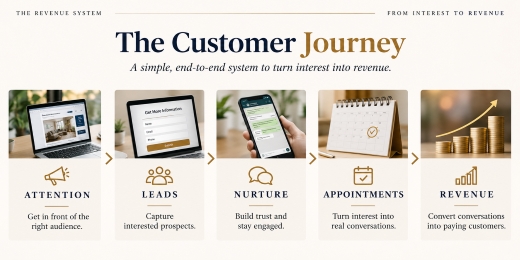
Leads can arrive through WhatsApp, Facebook, email, a website or a phone call. If no one is responsible for tracking them, some will inevitably be forgotten.
A shared spreadsheet or basic customer management system can be enough to begin.
Record when the inquiry arrived, who is handling it, what the customer needs and when the next action is due. Make sure one team member is accountable for each inquiry.
The goal is not to collect more data. It is to prevent interested customers from being lost because everybody assumed somebody else was handling them.
3. Make Customer Experience Repeatable
Imagine two customers buying the same service. One receives an immediate confirmation, clear instructions and a timeline. The other gets a short message and spends the next week asking for updates.
They paid for the same service, but they are having very different experiences.
Ozan recommends making onboarding consistent. That might mean a welcome message, a checklist of documents, a scheduled kickoff call and a clear explanation of what happens next.
Consistency reduces confusion for customers and prevents the owner from having to intervene whenever a project starts badly.
4. Automate Reminders, Not Relationships
Automation does not have to mean installing an expensive AI system.
For some SMEs, it can be as simple as appointment reminders, an acknowledgement when a customer submits an inquiry or an alert when a proposal has not received a reply.
Ozan sees automation as a way to make sure important tasks happen even when the team is busy.
The personal touch still matters. Sensitive complaints, complex decisions and high-value conversations deserve human attention. The advantage is that employees can spend more time on those moments when routine reminders are already handled.
5. Measure What Is Actually Slowing the Business Down
Many owners know their monthly sales figures. Fewer can immediately say how long customers wait for replies, how many quotations go unanswered or how often a new project needs the boss to step in.
Those numbers are worth tracking.
If inquiries are being answered quickly but sales remain weak, the problem may be the offer or the sales conversation. If customers are buying but complaining during onboarding, the next fix belongs after the sale.
Instead of changing everything at once, identify the weakest part of the process and improve that first.
The Real Test: What Happens When the Owner Is Away?
There is a revealing question Ozan wants entrepreneurs to consider: what would happen if you stepped away from the business for a week?
Would new inquiries still receive replies? Could your team issue quotations, confirm appointments and onboard clients? Would customers know who to contact? Would you return to a manageable list of decisions or a mountain of unresolved problems?
A business does not have to run perfectly without its founder. Owners will still make important decisions, build relationships and set direction.
But if every routine task stops when they are unavailable, growth will always come at a personal cost.
That is why Ozan encourages owners to think beyond hiring more people or spending more money on advertising. Adding staff to a confusing process can simply create more questions. Adding customers to an unreliable workflow can create more delays.
Build the process first. Then the people and tools have something dependable to work with.
For an SME owner who feels permanently on call, that may be the most useful definition of growth: not just higher sales, but a business that becomes more capable without demanding more hours from its founder.
Ozan’s message is straightforward. Being the hardest-working person in the company should not be the business model.

For more on his approach to business growth, read Fix Your System, Not Your Ads or visit www.ozanturay.com.
About ACE Digital SG
ACE Digital SG is a Singapore-based digital marketing agency that provides search engine optimisation, social media marketing, conversion rate optimisation, pay-per-click advertising, and web design and development. The company was incorporated in Singapore in October 2018 and is co-founded by Ozan Turay. Its mission is to help businesses build clearer marketing and sales systems that turn website visitors into customers.
Media Contact
Company Name: ACE DIGITAL SG PTE. LTD.
Contact Person: Ozan Turay
Email: Send Email
Phone: +65 8162 8293
Country: Singapore
Website: https://ozanturay.com
Media gallery



