
When a hail or wind claim gets denied, a Central Texas storm loss often becomes an argument about dates and what each inspection actually recorded. In Texas, the strength of your documentation usually decides whether the insurer’s stated reason can be tested at all. A renamed screenshot raises more questions than it answers. An original photograph with its capture date, or a complete inspection report, answers them. So keep the original denial letter.
Your file needs to separate what you saw when you first discovered the damage from what you wrote down later. A later note still belongs in the record, provided you say where it came from and when you made it. Just never pass it off as something written that day.
Build the file for denied insurance claims in Texas
Start with records that establish the claim and denial
Gather the policy and endorsements effective on your reported loss date, the claim acknowledgment, the denial letter, inspection reports, estimates, photographs, videos, emails, text messages, invoices, and telephone notes. Whenever possible, keep each item’s original date and sender, plus its filename and format. Set the denial next to the applicable policy, but don’t assume coverage exists. Note the insurer’s stated reason and any policy language the letter cites.
Insurers deny hail and wind claims for particular reasons, and the ones that matter here usually fall into a few buckets: a missed deadline, an unexamined roof slope, or a causation finding. Dated records can challenge any of them. Attorneys who handle denied insurance claims in Texas rely on exactly this kind of documentation, so build the file first, then decide your next move.
Document the storm damage step by step
- Save the denial letter and claim notices in their original electronic formats.
- Set up a read-only folder for originals and a separate working folder for notes or annotated copies.
- Preserve original photographs and videos before you edit or rename any copies.
- Group estimates and reports by issuer and date, and keep every revised version.
- Export emails and text exchanges. Follow up important phone calls with a dated email confirming what was said.
- Create an issue log identifying the inspected area and each evaluator’s conclusion. Mark what remains disputed.
Never overwrite the originals. Label working copies something like “north-roof-slope-annotated,” and keep the untouched file and its original metadata alongside them.
Make photographs useful as records
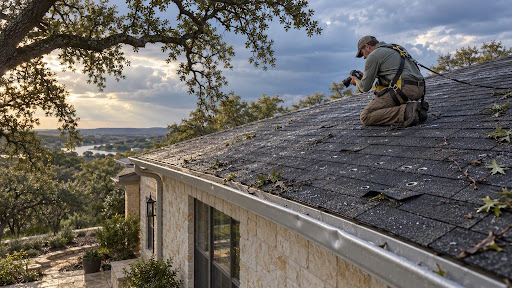
Take an overview photograph that identifies the property area, then take closer views of the visible condition. Photograph temporary repairs before and after the work, and retain invoices for tarps or other mitigation materials. Stay where you can safely stand.
A photograph documents visible conditions at a particular time, not a determination of storm causation. Record who took it and when, and identify its location on the property in a separate photo index.
How to keep a claim timeline after an insurance denial
Record events when they happen
Log the reported loss date and claim submission, followed by each information request and inspection. Include the denial and all reassessment exchanges. Link each entry to its supporting record, and keep discovery dates separate from the reported storm date.
| Claim event | Date and time to record | Supporting record | Follow-up to track |
| Damage discovered | When the condition was first observed | Original photographs or video | Temporary protection and related receipt |
| Claim reported | Submission date and confirmation time | Claim acknowledgment and claim number | Insurer’s information request |
| Property inspected | Inspection date and arrival time | Appointment notice and resulting report | Uninspected areas or requested documents |
| Denial received | Date delivered | Complete denial letter | Reason and cited policy language |
| Reassessment requested | Date sent | Email or certified-mail record | Written response and inspection date |
Use Texas deadlines as checkpoints, not assumptions
Under Texas Insurance Code Chapter 542, Section 542.057 generally requires payment within five business days after notice accepting a claim. Section 542.059 allows an additional 15 days for applicable claim-handling deadlines involving qualifying weather-related catastrophes or major natural disasters. Keep any catastrophe-extension notice in your file.
The Texas Department of Insurance says insurers generally have 15 business days after receiving notice to acknowledge a claim, begin investigating, and request reasonably necessary information. After receiving the required information, they generally have 15 business days to accept or reject the claim in writing. If an insurer needs more time, it generally must explain why in writing and then has up to 45 days to decide. A rejection must include a written reason. Retain the complete notice.

Record what arrived and when rather than declaring a deadline violation. Calculations can depend on requested information or a qualifying catastrophe extension, so preserve delivery confirmations and outstanding requests.
Should I get a second inspection after a denied claim?
Compare conclusions without rewriting them
A second inspection can help clarify a denied claim when the first report omitted an area or left a contractor’s documented observations unaddressed. It may also help when another qualified evaluator disputes a finding supporting the denial. A second inspection does not guarantee a changed outcome. Identify the specific finding you want reviewed, such as an unexamined roof slope.
| Source | Record exactly | Comparison question |
| Contractor estimate | Observed damage and proposed work; quantities and estimate date | Does it address the same property area as the insurer’s inspection? |
| Adjuster report or denial | Area reviewed and stated conclusion; cited policy wording | Which findings support the written decision? |
| Engineer report | Inspection date and materials reviewed; testing described and final opinion | Which observations differ from the other reports? |
Request the second inspection in writing and identify the areas or findings needing review. Reference supporting photographs by filename and reports by page number. If a contractor or another evaluator attends, separately record who was present and what each person inspected.
Keep the reports separate rather than combining them. Quote competing conclusions in your comparison notes instead of replacing them with your interpretation, and identify the source page for each quotation.
What to do after a Texas property damage claim is denied
Test the reassessment request for specificity
After an insurer denies a Texas property damage claim, send a written reassessment request identifying the claim and referencing the denial. State which findings need reconsideration and connect each point to a supporting record. Ask for a written response and retain proof of delivery.
Describe disagreements without accusations. For example: “The adjuster’s report does not address the interior ceiling condition shown in the attached photographs.” Identify the room and photograph filenames rather than alleging dishonesty.
Identify what kind of disagreement remains
Coverage concerns whether the policy applies to the reported loss. Scope concerns which damaged components are included. Value concerns the amount assigned to repair or replacement. Compare the denial with the policy and reports, then note the disputed wording in your issue log.
If a report references an attachment you never received, request it by title and date. Mark the gap “requested, not received,” and save that request.
Before asking for appraisal or another inspection, gather the governing policy, denial, and chronology. Include competing estimates alongside inspection reports and original photographs. Read the actual appraisal clause before requesting that process, because availability can depend on policy wording and the dispute. Keep questions for legal advice tied to specific documents.
Find guidance on an unresolved denial
A written reassessment request sometimes resolves a denial, and sometimes it does not. When a complete denial stands after reassessment, the next steps depend on the type of dispute, the policy’s appraisal clause, and the strength of your documentation, which is why the file you built earlier matters most at this stage.
A record another reader can follow
A useful claim file lets someone unfamiliar with your home connect each event to its original record and see exactly where conclusions diverge. You do not need to reconcile competing opinions yourself. Preserve them accurately, and clearly distinguish later recollections from observations recorded during an inspection. Unanswered requests should remain visible rather than disappearing into an email folder. The result should be a dated file containing the governing policy and denial, with an unresolved-issue log pointing to original photographs, reports, and correspondence.
Sources
- Texas Insurance Code Chapter 542.
- Texas Department of Insurance: Insurance claim deadlines.
Distributed By: Pulsebulletin.com


