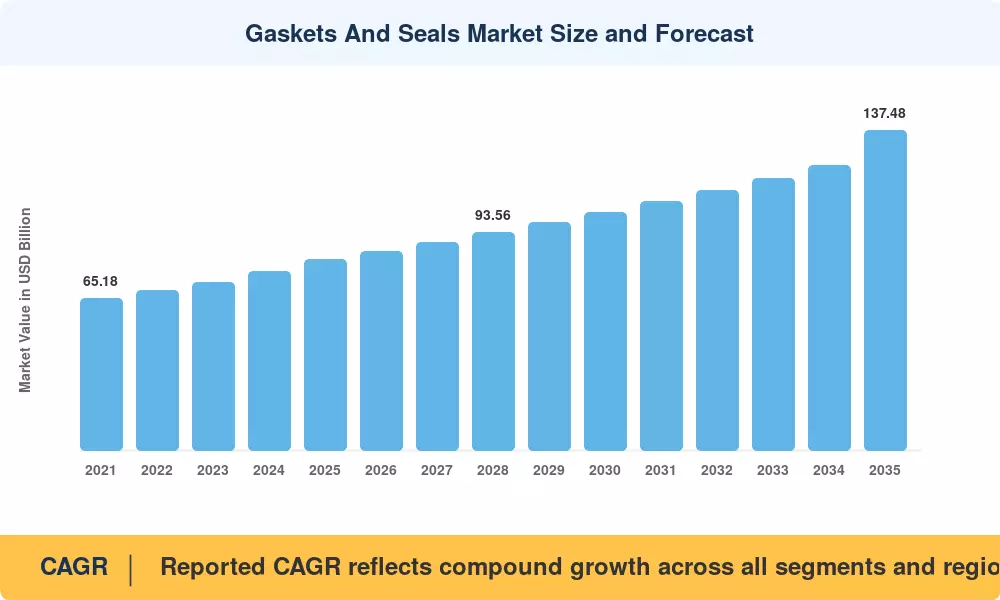
The Gaskets and Seals Market stood at an estimated USD 82.12 billion in 2025 and is projected to reach USD 85.58 billion in 2026
NEW YORK, NY, UNITED STATES, July 29, 2026 /EINPresswire.com/ — The Gaskets and Seals Market stood at an estimated USD 82.12 billion in 2025 and is projected to reach USD 85.58 billion in 2026 before climbing to USD 137.48 billion by 2035, registering a CAGR of 4.56% during 2026–2035.
Market Overview
Gaskets and seals are critical static and dynamic sealing components designed to prevent the leakage of fluids, gases, and particulates between mating surfaces in industrial and automotive applications. Gaskets are typically static seals placed between stationary flanges to create a tight barrier, while seals are dynamic components used in rotating or reciprocating equipment such as shafts, pistons, and valves to contain fluids under pressure. These components are manufactured from a diverse range of materials including metals, rubber, fiber, graphite, PTFE, cork, and advanced composites, each selected based on specific application requirements for temperature resistance, pressure tolerance, chemical compatibility, and durability. The market serves a broad spectrum of end-use industries including oil and gas, automotive OEM, aerospace and defense, chemical processing, power generation, marine, mining, and pharmaceuticals.
Two catalysts anchor this trajectory: first, the global push to expand LNG regasification capacity — with over USD 45 billion committed to new terminals between 2024 and 2030 — is driving demand for spiral wound gasket flange assemblies rated to cryogenic service; second, electric-vehicle battery enclosure programs now require PTFE gasket chemical resistance standards that did not exist five years ago, creating an entirely new replacement cycle for automakers and Tier-1 suppliers.
Legacy compressed-fiber and cork-based sealing products are giving way to engineered elastomers and metallic gasket ring joint configurations designed for hydrogen-blend pipelines and high-pressure fuel-cell stacks. The U.S. Department of Energy’s Hydrogen Shot initiative targets USD 1/kg clean hydrogen by 2030, and every new hydrogen pipeline segment demands O-ring sealing elastomer components certified to ISO 23936-2. Meanwhile, fire safe valve seal certifications under API 607 continue to tighten, forcing midstream operators to accelerate replacement schedules for gate and ball valve assemblies.
Industry trends indicate a decisive shift toward smart, sensor-enabled sealing systems and sustainable material solutions. Operators may now monitor fugitive emissions and bolt-load relaxation in real time thanks to embedded RFID and piezoelectric sensors, transforming a passive commodity into a data-rich service offering. After implementing smart spiral wound gasket flange assemblies, early adopters of LNG report a 30% decrease in unscheduled shutdowns. Leading manufacturers are investing heavily in sustainable sealing solutions, including fluoro-rubber compounding capacity for EV applications and bio-based elastomers, aligning with tightening ESG regulations and circular economy imperatives.
Technological developments are rapidly expanding the market’s capabilities and service models. Digital-twin platforms are enabling plant operators to model bolt-load degradation and elastomer aging in real time, shifting gasket replacement from calendar-based to condition-based scheduling. Smart gaskets embedded with piezoelectric sensors will become standard in critical LNG and hydrogen service by 2030. The integration of predictive maintenance analytics is converting one-time capital projects into recurring seal-replacement revenue streams. Advances in material science are enabling the development of perfluoroelastomer and fluoro-silicone compounds that withstand battery-pack temperatures exceeding 200 °C while maintaining chemical resistance to electrolyte solvents.
📍 Get Free Sample Report for Detailed Market Insights:
https://www.marketresearchfuture.com/sample_request/11627
Market Segmentation
By Product
The market is segmented by product into Seals (Shaft, Molded, and More) and Gaskets (Metallic, Rubber, Cork, and More). Seals accounted for approximately 62.3% of the Gaskets and Seals Market revenue in 2025, driven by hydraulic cylinder rod seal applications in mobile equipment and industrial automation. Shaft seals and molded seals serve critical functions in rotating equipment across oil-and-gas, automotive, and industrial-machinery applications. Gaskets are forecast to grow at a 3.38% CAGR through 2035, with metallic gasket ring joint variants gaining share in LNG turnaround cycles as spiral wound gasket flange assemblies transition from graphite-filled to PTFE-filled configurations for hydrogen and cryogenic service.
By Material
Material segmentation covers Metals, Rubber, Fiber, Graphite, and Others (PTFE, Cork, Composites). Metals represented the leading material category in 2025, anchored by spiral wound gasket flange demand in petrochemical and power-generation facilities where pressure ratings exceed 2,500 psi. Rubber compounds are expanding at the fastest pace, with a 6.65% CAGR, as automakers specify O-ring sealing elastomer solutions using next-generation fluoro-silicone and perfluoroelastomer grades for battery thermal management. Fiber accounts for USD 11.42 billion in 2025, serving general industrial compressed-fiber gasket applications. Others, including PTFE, cork, and composites, represent USD 8.76 billion, driven by PTFE gasket chemical resistance requirements in chemical processing.
By Sales Channel
Sales channel segmentation includes OEM and Aftermarket / MRO. OEM shipments constituted roughly 60.1% of the 2025 Gaskets and Seals Market turnover, reflecting strong original-equipment integration cycles across automotive and industrial applications. Aftermarket/MRO purchases will accelerate at a 5.34% CAGR as petrochemical operators extend asset life cycles beyond 30 years, driving recurring replacement demand for fire safe valve seals and hydraulic cylinder rod seal assemblies.
By Application
Application segmentation covers Oil and Gas, Automotive OEM, Aerospace and Defense, Chemical Processing, Power Generation, and Others (Marine, Mining, Pharma). Oil and gas held approximately 42.1% of the 2025 value, underpinned by fire-safe valve seal mandates across upstream and midstream operations. Automotive OEM demand is advancing at the fastest rate through 2035 with a 7.35% CAGR, fueled by EV battery-enclosure sealing requirements and SAE J3277 compliance. Aerospace and Defense represents USD 5.18 billion, serving engine nacelle and fuel-system sealing. Chemical Processing grows at 4.28% CAGR, driven by PTFE gasket chemical resistance requirements. Power Generation accounts for USD 4.67 billion, serving turbine casing and HRSG sealing.
By Region
Regional segmentation includes North America, Europe, Asia Pacific, South America, and the Middle East and Africa. Asia-Pacific generated the largest share at 44.2% of 2025 revenue and is climbing at the quickest CAGR among all regions. North America holds the second-largest share at approximately 22.8%. Europe accounts for a significant share with a 4.91% CAGR.
🛒 You can buy this market report at:
https://www.marketresearchfuture.com/checkout?currency=one_user-USD&report_id=11627
Regional Analysis
Asia-Pacific
Asia-Pacific commands roughly 44.2% of global revenue, led by China’s aggressive new-energy-vehicle build-out and India’s refinery modernization push. China accounts for 48.3% of regional revenue, with new-energy-vehicle output exceeding 12 million units in 2025, driving precision PTFE gasket chemical resistance–rated seals for battery packs. India is the fastest-growing major market at a 6.84% CAGR, with ongoing refinery capacity additions including the 60 MTPA Ratnagiri project generating large-scale spiral wound gasket flange procurement cycles. Japan contributes USD 4.52 billion in 2025, with its Green Transformation program allocating ¥20 trillion toward hydrogen and ammonia infrastructure, directly boosting demand for hydrogen-certified sealing products. South Korea grows at 5.47% CAGR, driven by battery gigafactories and shipbuilding MRO. ASEAN accounts for USD 3.89 billion, with refinery expansion and palm-oil processing sustaining demand.
North America
North America holds the second-largest share at approximately 22.8% of global revenue, buoyed by wind-turbine repowering programs and shale-gas infrastructure maintenance. The United States accounts for 68.4% of regional revenue, benefiting from a convergence of hydrogen pilot investment, LNG export terminal construction along the Gulf Coast, and methane-penalty enforcement under EPA OOOOb/c rules. Hydraulic cylinder rod seal procurement is accelerating across Permian Basin operators retrofitting aging wellhead assemblies. Canada grows at a 5.21% CAGR, with LNG Canada Phase 2 and oil-sands turnarounds generating incremental spiral wound gasket flange orders through 2028. Mexico contributes USD 1.74 billion in 2025, driven by the Dos Bocas refinery and nearshoring wave.
Europe
Europe’s Gaskets and Seals Market is propelled by the EU Green Deal Industrial Plan and its embedded hydrogen corridor mandates, with a 4.91% CAGR through 2035. Germany leads regional demand at 24.6% of European revenue, with its decision to repurpose over 4,500 km of natural-gas pipelines for hydrogen blending by 2035 requiring ISO 23936-certified metallic gasket ring joints and O-ring sealing elastomer replacements at every flange connection. The United Kingdom grows at 4.78% CAGR, driven by offshore wind O&M and North Sea decommissioning. France contributes USD 2.14 billion in 2025, with nuclear fleet life extensions and hydrogen corridors. Italy grows at 3.94% CAGR, with refinery conversions to bio-feedstock. Spain contributes USD 1.28 billion, with green-hydrogen export terminals. Nordic countries grow at 5.12% CAGR, driven by offshore wind and battery gigafactory sealing.
South America
South America accounts for a smaller share, with Brazil contributing 61.8% of regional revenue at USD 4.28 billion in 2025. Brazil’s pre-salt deepwater FPSO fleet—the largest in the world—sustains steady demand for fire safe valve seal assemblies and hydraulic cylinder rod seal components rated for high-pressure subsea service. Argentina grows at 4.64% CAGR, with Vaca Muerta shale development attracting midstream pipeline investment. The Rest of South America contributes USD 0.72 billion, serving mining and general industrial applications.
Middle East & Africa
The Middle East & Africa region, valued at USD 4.28 billion in 2025, benefits from Saudi Arabia’s downstream diversification under Vision 2030, including the Jafurah unconventional gas program generating multi-billion-dollar demand for metallic gasket ring joint and spiral wound gasket flange assemblies. Saudi Arabia accounts for 34.7% of regional revenue. The UAE grows at 4.43% CAGR, with ADNOC gas-cap development and early-stage hydrogen pilot projects at Masdar City. South Africa contributes USD 0.68 billion, with Sasol CTL maintenance and mining. Egypt grows at 4.18% CAGR, with East Mediterranean gas development.
Competitive Landscape / Key Players
The Gaskets and Seals Market exhibits medium concentration, with the top five players collectively holding 28–35% of global revenue. Key companies operating in this market include Freudenberg Sealing Technologies (~5–8% share), Trelleborg AB (~4–7%), SKF Group (~4–6%), Parker Hannifin (~4–7%), EnPro Industries (Garlock) (~3–5%), Flowserve Corporation (~3–5%), Dana Incorporated (~2–4%), John Crane (Smiths Group) (~3–5%), Tenneco Inc. (~2–4%), and Klinger Group (~2–3%).
Strategic developments in the market include significant capacity expansions and acquisitions. In March 2025, Freudenberg Sealing Technologies opened a USD 120 million fluoro-rubber compounding plant in Suzhou, China, expanding capacity for battery-enclosure O-ring sealing elastomer products by 40%. In January 2025, Parker Hannifin acquired a specialty PTFE gasket chemical resistance manufacturer in Texas, adding hydrogen-certified product lines to its spiral wound gasket flange portfolio. In November 2024, Trelleborg AB launched a sensor-embedded hydraulic cylinder rod seal series integrated with predictive-maintenance analytics platforms.
Competitive differentiation increasingly hinges on material science capabilities, hydrogen-certification portfolios, and digital-service offerings. Companies with captive compounding of fluoro-rubbers capture 300–500 basis points of additional gross margin and secure raw-material supply against fluoropolymer price swings. First-movers that establish hydrogen-grade PTFE gasket chemical resistance portfolios can command premium pricing and lock in long-term supply agreements across the seven U.S. Regional Clean Hydrogen Hubs.
Latest Industry News & Developments
Recent industry developments highlight the ongoing transformation of the gaskets and seals market toward hydrogen readiness, smart sealing systems, and EV-specific solutions. In March 2025, Freudenberg Sealing Technologies opened a USD 120 million fluoro-rubber compounding plant in Suzhou, China, expanding capacity for battery-enclosure O-ring sealing elastomer products by 40%. This investment reflects the surging demand for EV battery sealing solutions in the Asia-Pacific region.
In January 2025, Parker Hannifin acquired a specialty PTFE gasket chemical resistance manufacturer in Texas, adding hydrogen-certified product lines to its spiral wound gasket flange portfolio. This acquisition positions Parker Hannifin to capture emerging demand from the U.S. Department of Energy’s Regional Clean Hydrogen Hubs initiative.
In November 2024, Trelleborg AB launched a sensor-embedded hydraulic cylinder rod seal series integrated with predictive-maintenance analytics platforms. The product launch demonstrates the industry’s shift toward smart, condition-based sealing solutions that reduce unplanned downtime and enable data-driven maintenance strategies.
Market Challenges & Opportunities
Key restraints facing the gaskets and seals market include raw-material price volatility, with PTFE resin costs increasing 38% due to fluorspar supply interruptions and stricter PFAS restrictions, and nickel prices fluctuating between USD 15,000 and USD 30,000 per tonne. Counterfeit and substandard seal imports, accounting for 8–12% of aftermarket unit volumes in developing markets, erode consumer confidence and pose safety risks. Extended plant turnaround intervals, as refineries push intervals from four to six or even eight years, directly reduce the frequency of gasket and seal replacements. Skilled-labor shortages in precision machining and substitution risk from adhesive bonding technologies further constrain growth.
Emerging opportunities in the market are substantial and diverse. Smart gaskets and sensor-enabled sealing systems present a significant opportunity, with embedded RFID and piezoelectric sensors enabling real-time monitoring and reducing unscheduled shutdowns by 30% in early LNG adopters. Hydrogen-economy sealing standards, with ISO 23936-2 certification still nascent and fewer than 15 global manufacturers holding full compliance, offer first-movers premium pricing and long-term supply agreements across U.S. hydrogen hubs. Emerging-market refinery build-out, with Sub-Saharan Africa and South Asia adding over 4 million barrels per day of refining capacity by 2032, creates greenfield procurement channels. Aftermarket-as-a-service and data monetization, with major manufacturers piloting subscription-based replacement programs tied to digital-twin analytics, stabilize revenue and improve demand forecasting.
Future potential lies in semiconductor fab cleanroom sealing, with over USD 500 billion in fab investment through 2030 driving demand for ultra-clean O-ring sealing elastomer products rated for corrosive process gases. The electrification supercycle will reshape product mix, shifting revenue toward engineered elastomers for EV battery packs and away from traditional metallic products. Hydrogen infrastructure scale-up, with cumulative global investment forecast to exceed USD 600 billion by 2035, will see hydrogen-grade products grow at roughly double the overall market rate. ESG reporting and fugitive-emission accountability will convert discretionary maintenance into compliance-driven capital expenditure.
To explore more market insights, visit us at:
https://www.marketresearchfuture.com/reports/gaskets-and-seals-market-11627
Final Market Summary
The gaskets and seals market is positioned for steady growth through 2035, driven by LNG capacity expansion, EV battery-enclosure sealing mandates, hydrogen-pipeline retrofit programs, and tightening fugitive-emission regulations. The projected valuation of USD 137.48 billion reflects sustained demand across oil and gas, automotive OEM, aerospace, and chemical processing sectors, with the market transitioning from legacy compressed-fiber and cork-based products to engineered elastomers, metallic gasket ring joints, and smart sensor-enabled sealing systems.
The medium-term growth outlook remains positive, with the market registering a CAGR of 4.56% during the forecast period. Asia-Pacific will continue to lead market expansion through China’s NEV production and India’s refinery modernization, while North America and Europe maintain significant positions through hydrogen infrastructure investment and fugitive-emission compliance. The ongoing development of smart gaskets, hydrogen-certified sealing products, and sustainable material solutions will continue to expand market possibilities and applications.
Long-term industry potential extends beyond the current forecast horizon. Digital twins and predictive seal replacement will shift gasket replacement from calendar-based to condition-based scheduling, with smart gaskets becoming standard in critical LNG and hydrogen service by 2030. The electrification supercycle will reshape the product mix, shifting revenue toward engineered elastomers for EV battery packs. Hydrogen infrastructure scale-up will see hydrogen-grade products grow at roughly double the overall market rate, with cumulative global investment exceeding USD 600 billion by 2035. ESG reporting and fugitive-emission accountability will convert discretionary maintenance into compliance-driven capital expenditure. Manufacturers that successfully develop smart sealing solutions,
More Related Reports from MRFR Library:
Commercial Fitness Equipment Market: https://www.marketresearchfuture.com/reports/commercial-fitness-equipment-market-31094
Electric Lift Truck Market: https://www.marketresearchfuture.com/reports/electric-lift-truck-market-31181
Ac Servo Motors And Drives Market: https://www.marketresearchfuture.com/reports/ac-servo-motors-and-drives-market-31191
Industrial Transmitter Market: https://www.marketresearchfuture.com/reports/industrial-transmitter-market-31281
Marinas Market: https://www.marketresearchfuture.com/reports/marinas-market-31282
Operator Training Simulator Market: https://www.marketresearchfuture.com/reports/operator-training-simulator-market-31283
Small Caliber Ammunition Market: https://www.marketresearchfuture.com/reports/small-caliber-ammunition-market-31334
Water Source Heat Pump Market: https://www.marketresearchfuture.com/reports/water-source-heat-pump-market-31381
Multi Deck Refrigerated Display Cases Market: https://www.marketresearchfuture.com/reports/multi-deck-refrigerated-display-cases-market-31386
Gear Manufacturing Market: https://www.marketresearchfuture.com/reports/gear-manufacturing-market-31427
Larry Wilson
WantStats Research And Media Pvt. Ltd.
+1 855-661-4441
email us here
Legal Disclaimer:
EIN Presswire provides this news content “as is” without warranty of any kind. We do not accept any responsibility or liability
for the accuracy, content, images, videos, licenses, completeness, legality, or reliability of the information contained in this
article. If you have any complaints or copyright issues related to this article, kindly contact the author above.

Media gallery